Authors: Hannah K. Allen, Graduate Student, Agronomy and Horticulture, Lincoln; Mitchell B. Stephenson, Associate Professor, PREEC, Scottsbluff; Daniel R. Uden, Assistant Professor, Agronomy and Horticulture, Lincoln.
Summary with Implications
This project evaluated Canopeo, a free smartphone app that estimates fractional green canopy cover (FGCC), as a tool for monitoring aboveground biomass in Nebraska Sandhills rangelands. Live biomass was significantly higher in August than in June with some variability by year. FGCC showed a moderately strong relationship with current-year live biomass collected in either June or August. These results indicate that, in addition to producers’ field knowledge, Canopeo images taken with a smartphone or digital camera can offer a quick, visual estimate of forage conditions. This method may help reduce the need for labor intensive and destructive biomass estimation while still supporting stocking rate adjustments and grazing decisions. However, appropriate models would first need to be developed in each grassland to ensure differences in plant communities are represented appropriately. Canopeo potentially offers a practical and accessible way to track seasonal changes in rangeland productivity.
Introduction
Real-time biomass estimation is valuable in rangeland systems and useful for informing stocking rates, plant responses to temperature and precipitation, and the effects of grazing on range condition and wildlife habitat. In Nebraska Sandhills rangelands, biomass can vary widely by topographical dune position (i.e., dune top, slopes, and interdunal areas). Sand dune formations vary in aspect and soil moisture content, with the greatest differences in plant community and forage production found between interdunal areas and upland positions.
Capturing variability in seasonal biomass and within areas of many different plant habitat types via traditional estimation techniques (e.g., clipping, drying, and weighing) is labor intensive and destructive. Hence, non-destructive tools that estimate forage biomass rapidly could provide opportunities to quickly gather information on forage biomass. While some studies have found linear relationships between visual canopy cover and biomass, this relationship is not universal and may vary depending on vegetation type, growth stage, and other site-specific conditions.
Canopeo© (http://www.canopeoapp.com) is a user-friendly image analysis software that measures the fractional green canopy cover (FGCC) of red-green-blue digital images by calculating the percentage of green pixels within them. Canopeo is available as a smartphone application and also through a desktop interface. Images taken at 90 degrees on the horizontal plane above the area of interest are uploaded into the application, green pixels are turned white automatically based on predetermined red-green and blue-green color thresholds, and the application outputs a percentage green cover from the images. This approach has potential utility for Sandhills rangeland monitoring, particularly in systems dominated by mixed-grass communities where producers and managers seek quick, inexpensive tools for estimating forage availability across diverse dune positions.
The primary goal of this study was to evaluate the utility of Canopeo software as a rapid tool for estimating live biomass in Nebraska Sandhills rangelands. We focused on mid-June and mid-August current-year live biomass harvests in both 2023 and 2024 to capture seasonal differences in cool- and warm-season grass growth. Specifically, we aimed to determine how well fractional green canopy cover (FGCC) reflects aboveground live biomass across years and growing season stages. By assessing these relationships across different dune positions and time periods, we hope to better understand the potential of Canopeo as a practical monitoring tool for producers and land managers.
Procedure
Study Site
This study took place at the University of Nebraska- Lincoln’s Barta Brothers Ranch near Rose, Nebraska in Rock and Brown Counties. Three ~150 acre pastures managed with a deferred rotational grazing system were used for the study. Within each pasture, twenty 4’ x 4’ feet wire livestock grazing exclosures were placed to exclude grazing. Five of the grazing exclosures were placed along each topographic position of the same dune complex (e.g., dune-top, north-facing slope, south-facing slope, and interdunal area). Grazing exclosures were moved 2-3 yards every year along the transect to limit compounding results from the previous year’s destructive biomass sampling.
Biomass Sampling
Biomass sampling occurred in both mid-June and mid-August 2023 and 2024. A 10” x 3’4” quadrat frame was placed randomly within one half of each grazing exclosure in mid-June and at opposite ends of the grazing exclosure for mid-August sampling. Plants within the frame were clipped at ground level and sorted by live and dead biomass. Samples were dried, weighed, and current-year live mass was recorded as pounds per acre.
Fractional Green Canopy Cover Estimation
Immediately prior to clipping, nadir photos of frames were taken from about 1-yard above to include the entirety of the frame. Photos were oriented to exclude large shadows. Images were processed by cropping images to include only the frame and uploaded into Canopeo. The fractional green canopy cover (FGCC) output was recorded (Figure 1).

Statistical Analysis
We examined differences in total live biomass across years (2023 and 2024) and months (June and August) using a two-way analysis of variance (ANOVA), treating the three pastures as replicates. We evaluated the relationship between fractional green canopy cover (FGCC) and total live biomass (lbs/acre) using simple linear regressions. Analyses were conducted separately for June and August to assess seasonal variation in the strength of this relationship. This approach allowed us to understand whether FGCC provides a reliable estimate of forage availability across different times and annual weather conditions.
Results
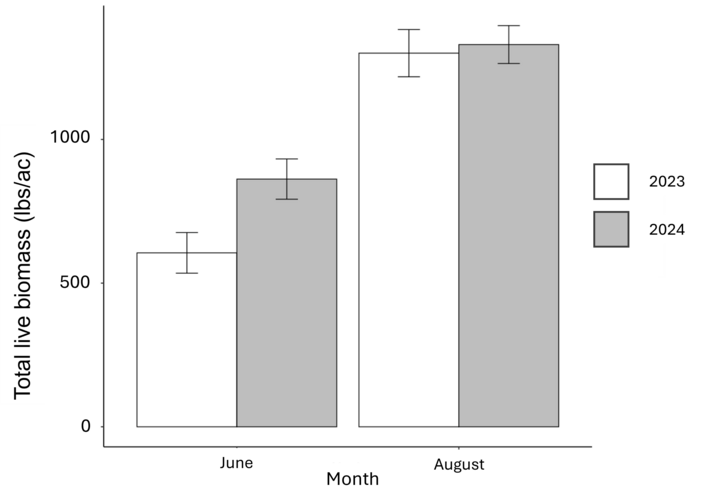
Seasonal differences in total live biomass were observed, with significantly higher live plant biomass values recorded in August compared to June (P < 0.001) (Figure 2), reflecting typical growth patterns of warm-season grasses later during the growing season. June 2023 live biomass was significantly lower than June 2024 live biomass (P < 0.001). Overall live biomass was also lower in 2023 than in 2024 (P = 0.03). These biomass differences by month and year follow yearly precipitation patterns. In 2023, there was 4.07 inches of rain between April and June, compared to 6.28 inches during the same period in 2024. This difference in rainfall may account for the higher live biomass observed in June 2024. From April to August, total precipitation in 2023 was 12.64 inches, while in 2024 it was 12.15 inches, indicating that mid- to late-summer rainfall was comparable between years. This suggests that early-season precipitation likely had a greater influence on June biomass differences, while August biomass was shaped more by growing season accumulation and plant phenology than by total rainfall alone.
Fractional green canopy cover (FGCC) showed a positive relationship with measured live biomass in both June and August. The strength of this relationship differed slightly by season, with FGCC explaining a moderate portion of the variation in biomass in June (R² = 0.51) and August (R² = 0.46) (Figure 3). In June, for every 1% increase in FGCC, there was around a 16 lbs/acre increase in total live biomass. For every 1% increase in FGCCC in August, there was a 21 lbs/acre increase in total live biomass. These findings suggest that there may be potential utility using FGCC as a rapid, nondestructive indicator of rangeland productivity in the Nebraska Sandhills. When timed appropriately during the growing season, this method offers producers and land managers a reliable and accessible option for monitoring forage conditions across years and pasture types. However, more research is needed to better understand plant dynamics and smaller scale variability in plant FGCC and biomass across different sites. Additionally, now that models have been developed, more data years will allow us to validate the efficacy of these models under different environmental conditions.

Conclusions
This study evaluated the use of fractional green canopy cover (FGCC), derived from Canopeo images, as a rapid, nondestructive tool for estimating rangeland biomass in the Nebraska Sandhills. FGCC showed a moderate, statistically significant relationship with live biomass in both June and August, supporting its continued evaluation as a practical monitoring approach during the growing season.
Overall, image-based canopy cover estimates like FGCC may help reduce reliance on time-consuming field methods while providing timely, useful information about forage conditions. However, further regression equations would need to be developed in each system to fully represent the plant community. Incorporating weather or soil moisture data may further improve future models for estimating biomass in semi-arid rangeland systems.
Acknowledgment
This project was funded by the USDA. The Nature Conservancy provided partial support for this work through the Nebraska Chapter’s J.E. Weaver Competitive Grants Program.
Copyright © 2025 The Board of Regents of the University of Nebraska. All rights reserved.