Authors: Alfredo DiCostanzo, Livestock Systems Extension Educator, Cuming County, West Point.
Summary with Implications
Cattle feeders or their nutritionists who rely on high-moisture corn (HMC) use a standard adjustment to energy content of the diet based on observation or previous research reports. Because moisture content of HMC is the result of many field and harvest factors, a common adjustment to the energy value of HMC applied to all conditions may not be appropriate. The hypothesis that moisture content of HMC determines its energy concentration was tested. Through a meta-analysis, it was determined that feed intake was depressed while energy content of HMC increased at greater moisture content. A simple method to estimate the moisture contribution from HMC to the diet was derived to enhance the applicability of dietary energy prediction equations using the contribution of HMC moisture to the diet.
Introduction
Feeding corn harvested at high moisture (HMC) generally leads to greater energy concentration than expected from dry rolled corn (DRC). Under field conditions, HMC is a term often applied loosely to corn harvested after kernels reach maturation but are not fully dried. Hybrid, planting and harvest dates, weather, soil conditions and harvesting method and speed, among other factors, affect the final moisture concentration of the kernel. The effects of these factors on moisture varies greatly from field to field and from season to season; therefore, moisture content of corn preserved as high moisture varies greatly. Moisture content of HMC samples vary from 19% to 27% within a given harvest year. The implications of moisture content on feed intake response or energy content of HMC have not been studied. It was hypothesized that moisture contained in corn stored as HMC is responsible for HMC effects on dry matter intake (DMI) and metabolizable energy (ME). The objective of this study was to determine the energy value of high-moisture corn through a meta-analysis.
Procedure
Replicated studies where inclusion of HMC as partial or full substitution of DRC conducted in the U.S. or Canada since 1987 with steers fed diets containing more than 60% were considered for inclusion in a meta-analysis (Table 1). References were sought from refereed publications or university research reports. Mean and standard deviation of weight (initial, IBW, and final, FBW), dry matter intake (DMI), average daily gain (ADG), hot carcass weight (HCW), rib fat depth (Fat), and longissimus dorsi area (LDA) were obtained from each reference for each of 14 studies. Adjusted final body weight (AFBW), determined from HCW, Fat and LDA, was used to determine study-level equivalent shrunk body weight (ESBW). Subsequently, dietary ME was determined from IBW, FBW, ESBW, ADG, and DMI.
Using reference ME values for non-corn grain dietary ingredients, non-corn dietary ME was calculated; remaining dietary ME was ascribed to DRC or HMC. A sequential mixed model (study as random) forward variable selection approach was used to derive best-fit (lowest -2 Res Log Likelihood) equations, weighted by the inverse of the dependent variable standard error, that described the relationship between HMC-moisture (HMC-M: moisture contributed by HMC to the grain mix as mass or proportion; DRC moisture set at zero) and DMI, ADG or ME.
Variable | Means, n | Mean | Std Dev | Minimum | Maximum |
| DRC, % DM | 18 | 89% | 2% | 88% | 91% |
| Days on feed | 18 | 135 | 45 | 99 | 168 |
| IBW, lb | 18 | 762 | 223 | 615 | 913 |
| FBW, lb | 18 | 1272 | 377 | 1008 | 1513 |
| DMI, lb/d | 18 | 23.84 | 6.88 | 18.96 | 29.11 |
| ADG, lb | 18 | 3.77 | 1.18 | 3.09 | 4.5 |
| HMC, % DM | 33 | 70% | 8% | 65% | 76% |
| Days on feed | 33 | 132 | 43 | 99 | 168 |
| IBW, lb | 33 | 792 | 275 | 615 | 1021 |
| FBW, lb | 33 | 1287 | 380 | 1005 | 1510 |
| DMI, lb/d | 33 | 23.46 | 6.86 | 17.93 | 28.22 |
| ADG, lb | 33 | 3.74 | 1.09 | 3.06 | 4.5 |
Results
Increasing the contribution of HMC-M to the grain mix by 1 lb or by its equivalent (13% in a diet containing 16.9 lb grain) reduced DMI by 0.42 (P = 0.0001) or 0.40 lb (P = 0.0005), respectively (Table 2). The P-value for the effect of HMC-M as mass or proportion on ADG was 0.664 or 0.654, respectively (Table 2). Yet, when including DMI as a covariate in the model predicting ADG from HMC-M as mass or proportion, a measure of gain efficiency, P-values were 0.0388 and 0.0267, respectively (Table 2). Increasing 1 lb HMC-M in the grain mix or its equivalent expressed as proportion (13%) led to an increase in HMC ME of 0.032 (P = 0.05) or 0.030 (P = 0.0001) Mcal/lb (Table 3). Moisture in HMC can be used to quantify HMC effects on DMI and ME value.
In this analysis, based on the premise that moisture in HMC contributes to greater energy content, moisture contribution of DRC is ignored. Therefore, when mixing HMC and DRC or using HMC as the grain source, estimates of energy effects may be made using the formulas derived herein. Additionally, a practical approach at determining the effect-size on dietary ME resulting from including HMC is derived below. It is based on the contribution of moisture from HMC stored at various moisture contents and assuming HMC is the sole grain source. After determining the moisture contribution by HMC at 100% inclusion, the user simply adjusts it to the expected or observed dietary contribution by HMC. This fraction is then multiplied by 0.188 (Table 3) to obtain an estimate of the effect of HMC-M on ME content of the diet (Mcal/lb).
| Variable | HMC-M | Intercept | SE | P-value | Linear | SE | P-value |
| DMI, lb | lb | 23.2 | 0.62 | <0.0001 | -0.423 | 0.093 | 0.0006 |
| DMI, lb | % | 23.21 | 0.62 | <0.0001 | -2.978 | 0.641 | 0.0005 |
| ADG, lb | lb | 3.66 | 0.112 | <0.0001 | 0.004 | 0.009 | 0.6645 |
| ADG, lb | % | 3.66 | 0.112 | <0.0001 | 0.03 | 0.067 | 0.654 |
| ADG, lb a | lb | 2.3 | 0.54 | <0.0001 | 0.027 | 0.013 | 0.0388 |
| ADG, lb b | % | 2.19 | 0.55 | <0.0003 | 0.221 | 0.097 | 0.0267 |
a Multiple regression model with DMI as additional covariate. Beta coefficient ± SE and P-value were: 0.058 ± 0.023, P = 0.0141. b Multiple regression model with DMI as additional covariate. Beta coefficient ± SE and P-value were: 0.063 ± 0.023, P = 0.0098. | |||||||
| Predictor | Linear | SE | P-value |
| lb | 0.032 | 0.015 | 0.0501 |
| % | 0.188 | 0.043 | <.0001 |
At 100% grain mix inclusion as HMC, moisture derived from HMC and its moisture content follow a curvilinear relationship (Figure 1). At the highest moisture content of HMC depicted in Figure 1 (35%) and using 100% HMC as the grain mix, the moisture contribution to the diet from HMC would be 54%. Using this figure to multiply by the coefficient derived for the relationship between moisture derived from HMC as a proportion of the diet and the expected change in ME concentration (0.188), results in an expected increase in ME of the diet of 0.10 Mcal/lb. Considering that this is the maximum moisture concentration one might harvest corn, then one would conclude that the maximum enhancement in ME content by using HMC would be 7%. This figure corresponds to previous reports in the literature.
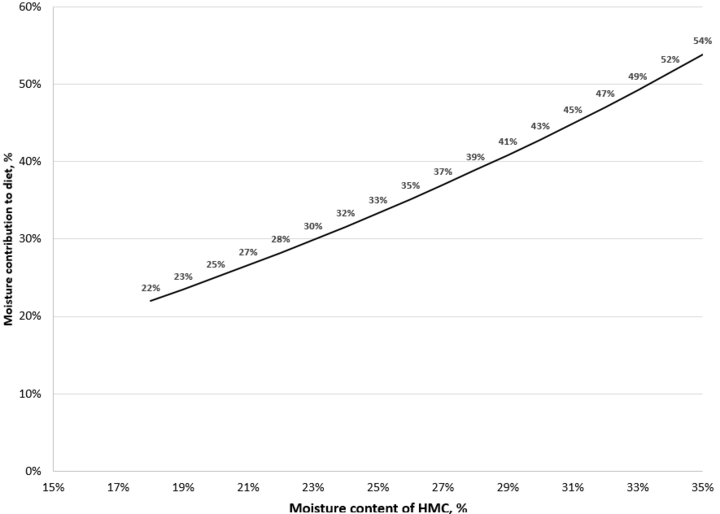
A more practical application of this concept might be to consider HMC with a moisture content of 28% used at a 50:50 ratio with DRC in a diet. Referring to Figure 1 for the moisture content of HMC (x-axis) then reading on the corresponding value on the y-axis, one would surmise that the moisture content derived from HMC in the diet would be 38.9%. Yet, the user would use half of this value as only 50% of the grain mix is comprised of HMC. Therefore, the user would expect a moisture contribution to the diet from HMC of 19.45%. Using this value to predict the enhancement in ME of the diet the user would obtain a value of 0.036 Mcal/lb (0.1945 x 0.188). This adjustment would be applied to dietary ME from which calculation of dietary NEm and NEg would ensue using the quadratic transformation between ME and NEm or NEg.
Copyright © 2025 The Board of Regents of the University of Nebraska. All rights reserved.