Authors: Dempster M. Christenson, Research Technician, WCREC, North Platte; Jordan M. Thomas, Assistant Professor, Animal Science (University of Missouri); Daniel J. Kelly (Zoetis); Rick N. Funston, Professor, WCREC, North Platte.
Summary with Implications
This study compared pregnancy rates of beef heifers artificially inseminated with multi-sire semen to single-sire semen. It was hypothesized pregnancy rates resulting from multi-sire semen would be increased compared to single-sire semen. Heifers were artificially inseminated with semen from one of three sires or semen from a combination of the same three sires. Pregnancy rates did not significantly differ. Paternity testing suggests sire parentage can be unequal when semen is mixed from multiple sires. In summary, similar pregnancy rates were observed using single-sire and multi-sire semen, but progeny may have unequal sire representation.
Introduction
Multi-sire (aka. heterospermic or sperm pack) semen is rarely used for artificial insemination (AI) when assignment of paternity is important, and the value of genotyping is low. However, previous studies reported pregnancy success increased 11–13 percentage points in heifers inseminated with multi-sire semen compared to single-sire AI. This increase is believed to be the result of interactions between compounds in seminal plasma and sperm from different sires and natural differences in optimal viability of sperm between sires, which may optimize matching of peak sperm and ovum viability, improving conception rates.
A breeding soundness exam is normally used to screen for poor quality semen but fails to identify differences between good quality semen samples that further bolster pregnancy rates to AI. Thus, producers choosing a sire from an AI catalog are not able to choose the most prolific sire. Considering the economic importance of generating pregnancies early in the breeding season, producers would likely consider the use of mixed sperm from multiple sires if this would result in greater pregnancy to AI. The objective of this study was to compare pregnancy rates of beef heifers artificially inseminated with semen from three sires in a single straw to single-sire semen.
Procedure
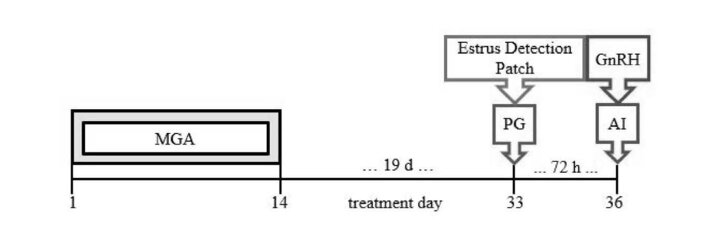
A ranch North of Sutherland, NE utilized 426 ± 24 head/yr (774 ± 72 lb) Angus crossbred spring calving beef heifers in 2022-2024. Estrus was synchronized with the melengestrol acetate – prostaglandin F2α timed-AI protocol (Figure 1). Melengestrol acetate (MGA; 0.5 mg/heifer per day) was mixed into the total ration provided in drylot for fourteen days. Nineteen days later, 2 ml prostaglandin F2α (PG; Lutalyse HighCon, Zoetis, Parsippany-Troy Hills, NJ) was administered, body weight was recorded, and estrus detection patches (EstrotectTM) were applied. Patch scores were recorded 72 hours after PG administration (1 = < 25% removed, 2 = 25 to 50% removed, 3 = > 50% removed). Patch scores less than three were recorded as not expressing estrus and were administered 2 ml gonadotropin releasing hormone (Factrel, Zoetis).
Three black Angus bulls were chosen for AI from the ABS Global (DeForest, WI) AI directory based on several criteria: no common sires among the bulls or among the bulls and the heifers, availability for simultaneous collection, ranch management choice, and consistent prior AI success as a sire owned by ABS Global. One collection was made from each bull (1, 2, 3) and allotted to either the single-sire treatments (SS1, SS2, or SS3; n = 135, 139, and 136, respectively) or the multi-sire (MS; n = 428) treatment, which contained a one third sample from each bull. ABS Global collected semen, diluted to a sperm concentration of 44 mil/ml, stored the sample in 0.5 ml semen straws, and froze in liquid nitrogen. A breeding soundness exam was performed on all three bulls, their individual semen, and the MS semen, which determined sperm morphology, motility, and survivability exceeded industry standards.
Treatments were administered 72 hours after PG administration in a repeating series of the three SS and MS treatments utilizing 10 semen straws for each SS and 30 straws for MS as heifers entered the chute. Unrelated bulls were introduced 7 days after AI and remained with the heifers for 37 ±7 d/yr. Pregnancy rate to AI was determined by fetal age performed by an experienced veterinarian using ultrasound 86 ± 4 days post AI. Body weight was also recorded at this time. After parturition, calves were genetically tested to determine sire paternity in Year 1 and 2 using an ear punch tissue sample (Quantum Genetix, Saskatoon, SK, Canada) that was submitted for genotyping.
Data were analyzed using PROC GLIMMIX of SAS 9.4 (Cary, NC USA). Heifer was the experimental unit. Pregnancy status and estrus response were analyzed as a response to each SS treatment, each SS treatment and the MS treatment, or the combined SS treatments and the MS treatment using contrast and estimate functions. Estrus response was included as a covariate. Data were considered significant at P ≤ 0.05 and a tendency if P < 0.10 and P > 0.05.
Results
Body weight at PG administration and pregnancy determination were not significantly different among treatments P ≥ 0.34). Average daily gain between these points was not significantly different among treatments (P = 0.80). The percentage of heifers detected in estrus was significantly different among treatments (SS1 = 70%, SS2 = 78%, SS3 = 77%, MS = 69%; P = 0.01), and significantly different between the SS (75%) and MS groups (P = 0.01). Estrous expression significantly differed between heifers that became AI pregnant and those that did not (P < 0.01). Due to the known influence of estrus expression on pregnancy rate, estrus response was included as a covariate on pregnancy rate. After adjusting for estrus response, pregnancy rate to AI was not significantly different among treatments (SS1 = 61%, SS2 = 58%, SS3 = 56%, MS = 58%; P = 0.74; Figure 2) and did not significantly differ between SS (58%) and MS treatments (P = 0.99). Contrasts between treatments pregnancy rate to AI were not significantly different (P ≥ 0.27). Final pregnancy rate after AI and natural breeding after the 44-day breeding season was 89%. Final pregnancy rate did not differ among treatments (SS1 = 90%, SS2 = 86%, SS3 = 90%, MS = 89%; P = 0.57), nor did pregnancy rate differ between SS (89%) and MS treatment (P = 0.86).
Paternity was determined in 150 MS calves and confirmed in 142 SS calves in Year 1 and 2. Within the random sample of the MS treatment population, Bull 1 sired 13%, Bull 2 sired 44%, and Bull 3 sired 43%. Bull 1 tended to be less successful than Bull 2 or 3 (P = 0.06 and P = 0.06, respectively). This disparity between bulls was unexpected given the pregnancy rate of each sire in the SS treatments were similar.

Conclusions
Many producers use more than one sire for AI to avoid the risk of a poor performing sire. Methods that increase pregnancy rate to AI in heifers increase the lifetime productivity of those heifers and their progeny while decreasing costs associated with heifer development . Current results indicate pregnancy rate to AI with MS and SS semen is not significantly different, but the percentage of calves from each sire within the MS treatment tended to be. It is unclear what may be influencing these results.
Acknowledgment
We would like to thank Daniel J. Kelly for the use of his cattle and ranch, Zoetis for providing the prostaglandin and gonadotropin releasing hormone, and Estrotect for providing the estrus detection aids.
Copyright © 2025 The Board of Regents of the University of Nebraska. All rights reserved.