Authors: Ashley A. Hahn, Graduate Student; Leila G. Venzor, Research Technician; Shelley A. Curry, Grace C. Johnson, Graduate Students, Animal Science, Lincoln; Mary-Grace Danao, Associate Professor, Food Science and Technology, Lincoln; Ranjith Ramanathan, Professor, Oklahoma State University, Stillwater, OK; Gary A. Sullivan, Associate Professor; Jordan C. Wicks, Assistant Professor, Animal Science, Lincoln.
Summary with Implications
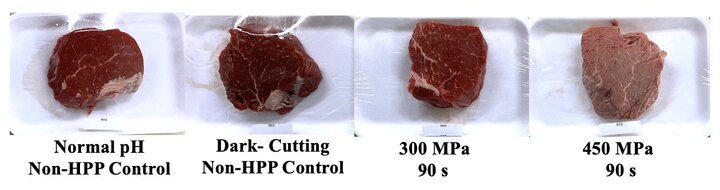
Dark-cutting beef is a quality defect that negatively impacts consumer appeal and affects the carcass value for both producers and meat processors. These economic losses stem from poor visual appearance and reduced consumer appeal in the retail setting. Notably, different muscles within a carcass exhibit varying degrees of color stability which can influence how dark-cutting manifests across cuts. Therefore, this study aimed to examine the effect of high-pressure processing (HPP) on dark-cutting color-labile muscle. Dark-cutting and normal tenderloins were collected and portioned into two equal sections. Dark-cutting tenderloins were assigned one of 3 treatments: No HPP, 300 MPa, or 450 MPa. Normal tenderloin steaks were used as controls and were not subjected to HPP. Steaks treated with 300 MPa were lightened to a lean color that closely resembled the color of the normal tenderloin control steaks. However, the 450 MPa steaks had excessive lightening and increased lipid oxidation, which indicates decreased shelf life and overall meat quality with this treatment. Therefore, the 300 MPa treatment has the most opportunity to improve dark-cutting tenderloin appearance.
Introduction
Preharvest stress in cattle can result in meat with an elevated pH and a distinct dark color, a phenomenon known as dark-cutting beef. This greatly reduces the value of the entire carcass due to its unappealing appearance for the consumer. High-pressure processing (HPP) has previously been noted to improve dark-cutting beef color in strip steaks. However, different muscles have different levels of color stability which could impact the effectiveness of HPP. Strip steaks are generally more color stable compared to the tenderloin which is color-labile and susceptible to quick color changes from bright cherry-red to brown when the muscle tissue interacts with oxygen. Therefore, the objective of this study was to examine the effect of HPP at varying pressures on a dark-cutting color-labile muscle, the tenderloin.
Procedure
Twelve dark-cutting (mean pH = 5.8) and six normal (mean pH = 5.4) tenderloins were collected from a commercial beef processor. To simulate shipping, tenderloins were held in cold storage (39°F ± 1) for 5 days. Following cold storage, tenderloins were cut into two sections, randomly assigned an HPP treatment, and vacuum packaged for treatment application. The normal pH tenderloins had no HPP treatment (Normal Control). Dark-cutting tenderloin sections were then assigned one of three treatments: No HPP (Dark-cutting Control), 300 MPa for 90 s (300 MPa), or 450 MPa for 90 s (450 MPa). Following HPP treatment, all tenderloins were held in cold storage (39°F ± 1) for an additional 48 h to simulate shipping. Following the 48 h storage, sections were cut into 1-inch thick steaks and subjected to a 7-day simulated retail display. Analyses of the retail displayed included daily instrumental and subjective color measurements on all tenderloin steaks, and pH and thiobarbituric acid reactive substances (TBARS) analysis on steaks collected on days 0, 3, and 7 to assess not only shifts in muscle pH but also lipid oxidation. Finally, Warner-Bratzler shear force (WBSF) was conducted on steaks collected on days 0 and 7 to better understand any difference in tenderness between treatments. Data were analyzed using the GLIMMIX procedure of SAS 9.4 for the main effect of HPP treatment within day using a randomized incomplete block design, and mean separation was determined at a significance of P ≤ 0.05.
Results
Meat Color
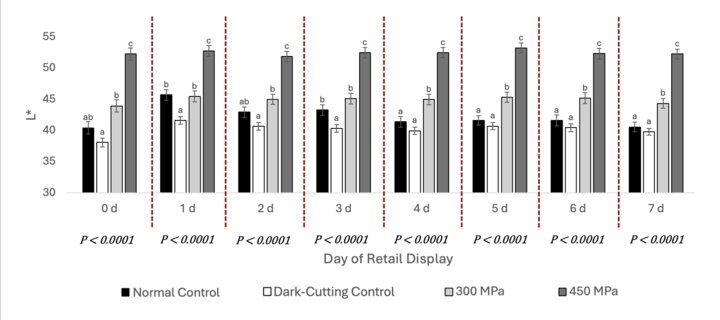
The observed color differences after HPP treatment in tenderloin samples are shown in Figure 1. Instrumental color is measured in terms of lightness (L*), redness (a*), and yellowness (b*). There was an HPP treatment effect for lightness (L*; P < 0.0001) for all retail display days (Figure 2). The 450 MPa steaks were the lightest for all days and the non-HPP dark-cutting control steaks were the darkest for days 1 and 3 and were similar in color to the normal pH controls for days 4 to 7. Additionally for redness (a*), there was a HPP effect for all retail days (P ≤ 0.0153) except days 1 (P = 0.1123) and 2 (P = 0.068). On day 0, the 450 MPa steaks were redder than the normal pH controls, but there is a shift by day 3 where the dark-cutting controls and the normal pH controls were redder than the 450 MPa steaks for the remainder of the retail display. For yellowness, the 450 MPa steaks were more yellow than the dark-cutting control for days 0-3 (P ≤ 0.013) and the 450 MPa steaks are the yellowest compared to all other treatments for day 4-7 (P ≤ 0.0019).
Subjective color was measured by a trained color panel for visual color scores, paleness scores, and surface discoloration. For visual color score, the 450 MPa steaks had the lowest color scores, indicating the lightest lean, for all retail days (P ≤ 0.0005). This was similar to paleness scores where the 450 MPa had the palest lean for all days (P < 0.0001). Furthermore, the 300 MPa steaks were paler than the dark-cutting control steaks for all days and the normal pH steaks for days 3-7 (P < 0.0001). For surface discoloration, the 450 MPa treatment had the greatest discoloration for days 1-3 (P < 0.0001) but there was no difference in the 300 MPa group for the remainder of the retail display (P ≤ 0.0097, Figure 3).

Laboratory Analyses
Thiobarbituric acid reactive substances (TBARS) was used to measure lipid oxidation, which impacts product shelf life, for days 0, 3, and 7 of retail display. For days 3 and 7, the 450 MPa steaks had the greatest lipid oxidation (P < 0.0001). The 300 MPa steaks had the next highest lipid oxidation values on day 3 but were not different from the normal pH steaks by day 7 (P < 0.0001). Additionally, tenderness was measured using WBSF on days 0 and 7. Steaks from the 450 MPa treatment were significantly tougher than that of the dark cutting controls on day 0 (P = 0.0148). This toughening effect continued, resulting in 450, MPa steaks having the highest WBFS values (toughest) on day 7. Although 300 MPa had improved tenderness compared to 450 MPa, the normal control steaks resulted in the most tender steak following a 7-day simulated retail display (P < 0.0001). Finally, when examining shifts in pH, we found no differences in pH other than the expected pH difference between the high pH dark-cutting and the normal pH tenderloins for all measured days (P ≤ 0.0012).
Conclusions
Dark-cutting tenderloins subjected to HPP were significantly lightened in color by HPP treatment. Specifically, steaks treated at 450 MPa for 90 s resulted in excessive lightening and paleness as well as increased lipid oxidation and negative effects on tenderness. However, steaks treated at 300 MPa for 90 s had improved color and closely aligned to that of the normal pH steaks, suggesting HPP may be a viable tool in helping to restore value back to an otherwise highly discounted product. More work is needed to better understand specific optimization of HPP parameters as well as shipping, storage, and display times.
Copyright © 2025 The Board of Regents of the University of Nebraska. All rights reserved.