Authors: Anna M. Kobza, Kyra L. Elliot, Anna G. Hilton, Graduate Student, Animal Science, Lincoln; Mitch L. Norman, Research Technician; Josh R. Benton, Feedlot Unit Director, ENREEC; Rebecca L. McDermott, Research Technician; Chad Russell, Graduate Student; Long Zou, Bunge, St. Charles, MO; Jim C. MacDonald, Professor; Galen E. Erickson, Professor; Jessie C. Morrill, Assistant Professors, Animal Science, Lincoln.
Summary with Implications
Rising costs and availability of supplemental fats have increased interest in alternative fat sources in feedlot finishing diets, including palm oils. This experiment evaluated how refined, bleached, and deodorized (RBD) palm oil products included in the diet of feedlot finishing steers affect beef fat color and ground beef shelf-life. Steers were fed diets with no supplemental fat (No Oil), corn oil (Corn Oil), whole palm (Whole Palm), palm stearin (Stearin), or palm olein (Olein) at 4% dietary DM. Subcutaneous fat from cattle fed corn oil was more yellow than that from No Oil or palm oils. Ground beef from cattle fed palm oils tended to have increased collagen and beef from Corn Oil, Stearin and Whole was higher in linoleic acid compared to No Oil. During simulated retail display, ground beef redness decreased for all groups, with Stearin and Whole Palm reducing in redness more by day 5. Results from this experiment indicate that inclusion of RBD palm oil products in the finishing diet has limited impacts on meat quality.
Introduction
In a feedlot nutritionist survey by Samuelson et al. (2016), 54.2% of feedlot nutritionists reported that their clients included supplemental fat in finishing diets. The most common sources cited by respondents were tallow (29.5% of respondents), fat blends (25%), yellow grease (16.7%), and corn oil (4.17%). While supplemental fat is primarily added to increase dietary energy density, it may also affect meat quality, an area that is less commonly considered in formulation decisions. Beyond traditional carcass metrics, supplemental fats may impact fat color, fatty acid composition, and the shelf life of meat products. However, increased demand for biofuels has increased fat prices and introduced greater variability in cost and availability, likely reducing the proportion of feedlots using supplemental fat today. Palm oil is a globally traded oil that does not currently qualify for biofuel credits in the U.S. and may be a more stable and cost-effective fat source compared to corn oil or tallow in certain market conditions. However, limited research exists on palm oil inclusion in diets typical of U.S. feedlots and subsequent impact on meat quality. The objective of this experiment was to evaluate the effects of including refined, bleached, and deodorized palm oil products in the finishing diet on beef fat color, fatty acid composition, and the shelf-life of ground beef.
Procedure
A finishing study was conducted at the Eastern Nebraska Research, Extension and Education Center using 320 crossbred steers (initial body weight (BW) = 836 lb ± 32) in a randomized block design. Procedures related to the finishing phase of this experiment are published in the 2025 Nebraska Beef Report (pp. 44–47). Briefly, steers were blocked by BW (light and heavy) and assigned randomly to pens (8 steers/pen; 40 total pens; 8 replicates/treatment). Pens were then randomly assigned to treatments and pen served as the experimental unit. There were 5 dietary treatments consisting of either no supplemental fat (No Oil), or supplemental corn oil (Corn Oil), whole palm oil (Whole Palm), stearin palm oil (Stearin), or olein palm oil (Olein). The supplemental fat sources were added to the final finishing diet which consisted of a blend of dry-rolled corn (DRC), high-moisture corn (HMC), modified distillers grains, and corn silage (Table 1). The No Oil diet was estimated to contain 4.2% fat whereas diets containing supplemental fat were estimated to contain 8.1% fat (DM basis).
Dietary Treatment | |||||
Item | No Oil | Corn Oil | Whole Palm | Olein | Stearin |
| Ingredient, % of DM | |||||
| Dry-rolled corn | 32.5 | 30.5 | 30.5 | 30.5 | 30.5 |
| High-moisture corn | 32.5 | 30.5 | 30.5 | 30.5 | 30.5 |
| MDGS 1 | 15 | 15 | 15 | 15 | 15 |
| Corn silage | 15 | 15 | 15 | 15 | 15 |
| Whole palm oil | - | - | 4 | - | - |
| Palm Stearin | - | - | - | 4 | |
| Palm Olein | - | - | - | 4 | - |
| Corn oil (distillers) | - | 4 | - | - | - |
| Supplement 2 | 5 | 5 | 5 | 5 | 5 |
1 MDGS = modified distillers grains plus solubles 2 Supplement provides Rumensin (30 g/ton of DM) and Tylan (8.8 g/ton of DM) along with mineralsand vitamins to meet or exceed nutrient requirements, along with urea for rumen degradable protein needs. | |||||
At the end of the finishing phase, steers were harvested at a commercial abattoir (Omaha, NE). During harvest, liver abscessation frequency and hot carcass weight were determined. Approximately 36-48 hours after harvest, marbling score, ribeye area (REA), 12th rib fat thickness were assessed using a commercial grading camera.
Immediately following grading, three carcasses per pen (n = 120) were selected for fabrication. From this subset of carcasses, untrimmed Beef Briskets (Institutional Meat Purchase Specification 120) were collected, vacuum packaged and transported to the Loeffel Meat Laboratory at the University of Nebraska – Lincoln. Briskets were selected because of their accessibility during fabrication, sufficient fat content for controlling lean to fat ratios and the presence of subcutaneous fat suitable for measuring fat color. Briskets were aged until 14 days postmortem and were then stored frozen until retail evaluation. At the time of evaluation, briskets were thawed at 39.2 °F for 2 days, then further cut and trimmed to Flat Cut Briskets (IMPS 120A), were portioned, and individually ground in a tabletop grinder using both a coarse- and fine-grind plate. After grinding, sub primal batches were thoroughly hand mixed.
Samples of ground beef were collected and evaluated for protein, fat, moisture, and collagen composition using a Foss Food Scan. Fatty acid composition of ground beef was determined by SDK Laboratories (Hutchinson, KS) using gas chromatography after total lipid extraction and FAME preparation.
From each individually ground brisket, six 0.25 lb ground beef patties were formed and placed into Styrofoam trays and overwrapped with oxygen permeable polyvinyl chloride for a 7-day simulated retail display and shelf-life trial. Objective color was evaluated in ground beef patties daily (Konica Minolta colorimeter) for 7 days. Chemical changes during the 7 days of display were assessed through measurement of thiobarbituric acid reactive substances (TBARS; mg malondialdehyde/kg meat homogenate) on days 0, 3, and 7 of simulated retail display.
Carcass and meat quality data were analyzed using analysis of variance (ANOVA) via the MIXED procedure of SAS, with pen as the experimental unit and block as a fixed effect. Differences were considered statistically significant when P ≤ 0.05 and a tendency when 0.05 < P ≤ 0.10.
Results
Carcass
Live performance data for this experiment are published in (2025 Nebraska Beef Report pp. 44–47). Hot carcass weight of cattle consuming Corn Oil, Olein, and Stearin was greater (P = 0.03, Table 2) than those consuming No Oil, but No Oil and Whole Palm were not different from each other. Marbling scores were greater (P = 0.01) for Olein and Stearin compared to Corn Oil and Whole Palm fat supplementation. There were no differences in 12th rib fat thickness, REA, or liver abscess incidence among treatments (P ≥ 0.74).
Treatments1 | |||||||
Items | No Oil | Corn Oil | Whole Palm | Olein | Stearin | SEM2 | P-value3 |
| HCW, lb. | 932b | 959a | 942ab | 951a | 957a | 6.4 | 0.03 |
| Marbling Score4 | 523ab | 506b | 505b | 552a | 551a | 10.4 | 0.01 |
| 12th-rib fat, in | 0.71 | 0.73 | 0.73 | 0.72 | 0.73 | 0.023 | 0.94 |
| Ribeye Area, in2 | 14.7 | 14.7 | 15 | 14.8 | 14.8 | 0.16 | 0.74 |
| Liver Abscesses, % | 13.4 | 12.5 | 14.3 | 12.7 | 12.7 | - | 0.99 |
1 No Oil = negative control, 0.0% added fat; Corn Oil = positive control, 4.0% corn oil; Whole Palm= 4.0% whole palm oil; Olein = 4.0% olein palm oil; Stearin = 4.0% stearin palm oil. 2 Standard error of the mean. 3Means within a row with different superscript letters differ, P ≤ 0.05. 4Leading digit in marbling number indicates marbling score; 200=trace00, 300=slight00, 400=small00, 500=modest00, 60000=moderate, 70000=slightly abundant, 80000=moderately abundant, 90000=abundant. Following digits indicate degree of marbling within marbling score. | |||||||
Meat Quality
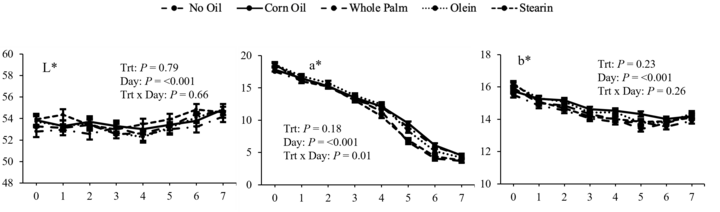
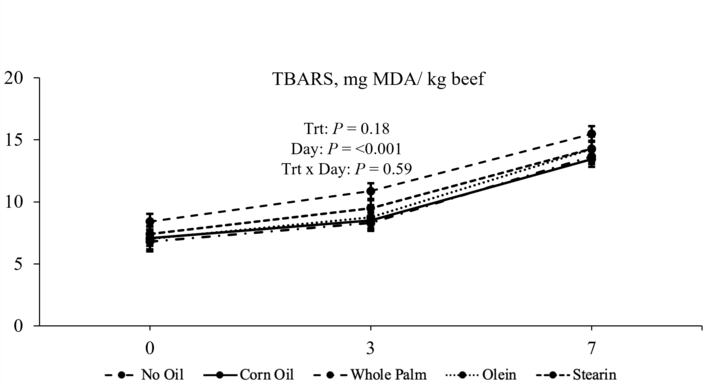
A significant effect of treatment was observed for yellowness of subcutaneous fat color (Table 3; P < 0.001). Subcutaneous fat from cattle provided Corn Oil was more yellow compared to fat from cattle provided No Oil, Olein, Stearin, or Whole Palm (P ≤ 0.05). Although fat color does not impact USDA Quality Grade, fat color is considered in some foreign markets where whiter fat is preferred. However, there was no effect of treatment on lightness or redness of subcutaneous fat (P ≥ 0.69). The increased yellowness of fat from cattle fed Corn Oil is likely attributed to the pigments present in corn oil; the corn oil used in this experiment had increased b* values compared to the other oils. This warrants further exploration, as it may be related to carotenoid content or vitamin A metabolism. The ground beef used in this study was formulated to contain approximately 85% lean and 15% fat to ensure similar fat and protein content across treatments. As intended and expected, moisture, protein, and fat composition of ground beef was not significantly different among treatments (Table 4; P ≥ 0.77). However, there was a tendency for ground beef from cattle fed palm oils to have increased collagen content compared to No Oil and Corn Oil treatments (P = 0.10). Interestingly, there was an effect of treatment on linoleic acid (18:2n-6) concentration of ground beef (Table 5); beef from cattle fed Corn Oil, Stearin and Whole Palm had increased proportions of linoleic acid compared to No Oil (P ≤ 0.05). The concentrations of 14:0, 16:0, 18:0, 18:1n-9, and 18:3n-3 were not impacted by treatment (P ≥ 0.38). During seven days of simulated retail display (Figure 1), there was no diet × day interaction (P ≥ 0.26) for L* and b* values. Overall, a* values, or redness, decreased from day 0 to day 7 for all treatments, but the rate that they declined differed, particularly at day 5 of the retail display. There was an interaction (P < 0.01) for a*, where cattle fed Stearin and Whole had lower a* values on day 5 compared to No Oil, Corn Oil, and Olein, indicating surface discoloration and a decrease in shelf life by 1 day. To estimate lipid oxidation, TBARS values were measured from samples on day 0, 3 and 7 of the retail display (Figure 2). There was no interaction of diet × day (P = 0.59) on TBARS mg MDA/kg beef and no main effect of dietary treatment (P = 0.18). From day 0 to day 7 however, there was increased TBARS, or lipid oxidation occurring (P < 0.01) for all dietary treatments.
Treatments1 | |||||||
Item | No Oil | Corn Oil | Whole Palm | Olein | Stearin | SEM2 | P-Value3 |
| Lightness, L* | 82.1 | 81.98 | 82.65 | 82.29 | 81.99 | 0.45 | 0.81 |
| Redness, a* | -0.69 | -1.14 | -0.87 | -0.63 | -0.5 | 0.327 | 0.69 |
| Yellowness, b* | 14.74a | 16.19b | 14.65a | 14.63a | 14.63a | 0.249 | < 0.001 |
1 No Oil = negative control, 0.0% added fat; Corn Oil = positive control, 4.0% corn oil; Whole Palm= 4.0% whole palm oil; Olein = 4.0% olein palm oil; Stearin = 4.0% stearin palm oil. 2 Standard error of the mean. 3Means within a row with different superscript letters differ, P ≤ 0.05. | |||||||
Treatments1 | |||||||
Item | No Oil | Corn Oil | Whole Palm | Olein | Stearin | SEM2 | P-Value3 |
| Moisture | 64.71 | 64.42 | 64.28 | 63.91 | 64.2 | 0.469 | 0.81 |
| Protein | 18.21 | 18.11 | 18 | 17.96 | 18.11 | 0.168 | 0.84 |
| Fat | 13.43 | 14.02 | 14.21 | 14.62 | 14.15 | 0.636 | 0.77 |
| Collagen | 1.99 | 1.98 | 2.13 | 2.07 | 2.13 | 0.054 | 0.1 |
1 No Oil = negative control, 0.0% added fat; Corn Oil = positive control, 4.0% corn oil; Whole Palm= 4.0% whole palm oil; Olein = 4.0% olein palm oil; Stearin = 4.0% stearin palm oil. 2 Standard error of the mean. 3Means within a row with different superscript letters differ, P ≤ 0.05. | |||||||
Treatments1 | |||||||
Item | No Oil | Corn Oil | Whole Palm | Olein | Stearin | SEM2 | P-Value3 |
| Fatty Acid, g/100 g FAME4 | |||||||
| 14:0 | 3.7 | 3.78 | 3.46 | 3.46 | 3.48 | 0.241 | 0.81 |
| 16:0 | 26.78 | 26.73 | 27.22 | 26.6 | 26.8 | 0.579 | 0.96 |
| 18:0 | 10.58 | 11.35 | 10.56 | 11.45 | 10.43 | 0.469 | 0.38 |
| 18:1n-9 | 47.96 | 47.71 | 47.95 | 48.02 | 48.29 | 0.772 | 0.99 |
| 18:2n-6 | 1.40b | 1.67a | 1.60ac | 1.52bc | 1.63ac | 0.052 | <0.01 |
| 18:3n-3 | 0.09 | 0.1 | 0.11 | 0.09 | 0.09 | 0.023 | 0.96 |
1 No Oil = negative control, 0.0% added fat; Corn Oil = positive control, 4.0% corn oil; Whole Palm= 4.0% whole palm oil; Olein = 4.0% olein palm oil; Stearin = 4.0% stearin palm oil. 2 Standard error of the mean. 3Means within a row with different superscript letters differ, P ≤ 0.05. 4FAME = fatty acid methyl esters | |||||||
Summary
Feeding supplemental fat, from palm oil derived or corn oil sources, increased HCW compared to feeding No Oil. Marbling score was highest in cattle consuming Olein and Stearin, although no other carcass characteristics were impacted by fat supplementation. While meat quality differences were generally subtle, palm oil products were associated with increased collagen content, which can negatively impact meat tenderness, and slightly reduced color stability during retail display. These findings suggest RBD palm oil derivatives can be viable fat sources in feedlot diets without compromising carcass or meat quality. Further research is warranted to explore the impact of palm oil derived fat sources on specific quality attributes like tenderness and fatty acid composition.
Acknowledgment
This research was funded by Bunge. Pharmaceutical products used in the live cattle portion of this study were provided by Elanco Animal Health and Merck Animal Health.
Copyright © 2025 The Board of Regents of the University of Nebraska. All rights reserved.