Authors: Anna G. Hilton, Graduate Student; Jessie C. Morrill, Assistant Professor, Animal Science, Lincoln.
Summary with Implications
The American Meat Science Association's USDA Grading Committee recently expressed the need for a proxy device to verify that various camera grading systems produce consistent readings. To fulfill this need, we developed a proxy device made from 3D printed epoxy resin and other materials. The proxy was designed to have a known fat thickness and ribeye area. The proxy has a ribeye area of approximately 14 square inches and a fat thickness that ranges from 0.4 - 0.6 inches depending on the exact measurement location. The amount of marbling in the proxy can be adjusted incrementally and when the number of marbling pieces in the proxy is fixed and the size of each marbling piece is controlled, the percentage of intramuscular fat, in pixels, is highly predictable.
Introduction
At present, approximately 90% of the fed cattle produced in the United States are graded according to USDA Agricultural Marketing Service Standards for Grades of Carcass Beef. There are two separate beef grading systems utilized: 1) the “yield grade,” which indicates the “yield of closely trimmed, boneless retail cuts expected to be derived from the major wholesale cuts of a carcass,” and 2) the “quality grade,” which is meant to predict “the palatability of the lean.” Along with the development of the Standards for Grades, the USDA has also developed used photographs and other objective aids to correctly apply grades, which include the USDA ribeye grid, the preliminary yield grade ruler, and marbling pictures.
Technological developments have driven the incorporation of camera/instrument grading systems in the beef industry. It is estimated that nearly 80% of fed cattle in the United States are now graded using camera technology. The USDA has established procedures for beef carcass instrument grading, which include standards for instrument startup, operation, and validation as well as carcass presentation, cooler conditions, and criteria for overriding camera grade calls. While instrument grading is arguably more objective than human visual or physical assessment of yield or quality grade indicators, there is still some error with instrument assessment.
To address some of the challenges with grading camera validation and to help ensure proper camera operation, the American Meat Science Association’s USDA Grading Committee expressed need for a shelf-stable, non-meat, 3D object that could be used in lieu of meat and instrument marbling cards. To fulfill this need, we developed and characterized a shelf-stable proxy-device that may be used to validate readings across and within grading camera equipment. Our objectives were to design a proxy device that could be used for validating camera readings related to amount of intramuscular fat, ribeye area, 12th rib fat thickness, and lean and fat color.
Procedure
The proxy device was 3D printed using white epoxy resin and filled with a shelf stable petroleum derivative (Figure 1). The “lean” and “fat” proxy substances were dyed using organic chemicals, which were chosen to imitate beef lean and fat color values, respectively. The proxy color values were assessed using a calibrated Chroma meter set to the D65 illuminant (CR-400; Konica Minolta; Ramsey, NJ), that provided Commission Internationale de l’Éclairage (CIE) color space values (L*, a*, and b*). Proxy dimensions were scaled using 3D print rendering software and were validated manually with a ribeye dot grid and USDA PYG ruler.

Proxy intramuscular fat content was quantified in photographs using Image J software. Briefly, photographs were taken of the proxy in a photo studio light box under controlled lighting using a Canon Rebel T3. Photographs were saved in .CR2 format and were converted to .tif files using Adobe Photoshop (Figure 2). The .tif files were then imported into ImageJ and were processed using a series of macros, where the output was ribeye area, fat thickness, and percentage intramuscular fat, in pixels, within the proxy “ribeye”. The percentage intramuscular fat is determined by calculating the proportion of white pixels within the total longissimus muscle relative to total pixels within the muscle. We validated that the approach used to assess the proxy could also be used to quantify ribeye area, fat thickness, and intramuscular fat in a photograph of a fresh beef steak imaged under the same conditions (Figure 3). Ribeye area and fat thickness are calculated using a calibration scale.


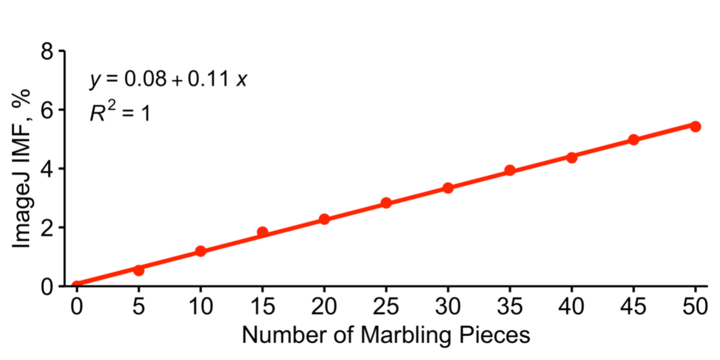
A simple linear regression and Pearson correlation were performed using R (version 4.0) and R Studio (tidyverse version 1.3.0, nlme, version 3.0) to determine the relationship between number of marbling pieces within the proxy and percentage intramuscular fat, in pixels. In this pilot study, 11 proxy device evaluations were performed; the proxy contained either 0, 5, 10, 15, 20, 25, 30, 35, 40, 45, or 50 pieces of marbling.
Results
The shelf-stable proxy has a ribeye area of approximately 90 square cm and a variable fat thickness that ranges from 1-1.5 cm, depending on the exact measurement location. The ribeye area and fat thickness of the proxy can be validated using ImageJ or conventional dot grids or probes. The material selected for the proxy’s ribeye has L*, a*, and b* values of approximately 50, 22, and 13, respectively. The material selected for the proxy’s subcutaneous fat and marbling has L*, a*, and b* values of approximately 80, 0, and 15, respectively. When the number of marbling pieces in the proxy is known, and the size of each marbling piece is controlled, the percentage intramuscular fat in pixels is highly predictable (P < 0.001; r > 0.99; Figure 4).
Conclusions
The proxy developed in this study has size, shape, and color properties that closely resemble fresh beef. Additional research is needed to determine if the proxy can be recognized and measured by beef grading systems that are used in commercial beef packing plants. Organic shapes and varied sizes of proxy marbling pieces are also being considered for future research so that the proxy is able to assist the camera in distinguishing between coarse and fine marbling. Varying intramuscular fat thickness to support yield grade estimation is another potential design feature. As remote grading continues to evolve, it will also be necessary to determine if the proxy can be recognized by more economical phone-based grading systems.
Acknowledgment
This research was funded by the American Meat Science Association.
Copyright © 2025 The Board of Regents of the University of Nebraska. All rights reserved.