Authors: Ashley A. Hahn, Graduate Student; Leila G. Venzor, Research Technician; Shelley A. Curry, Grace C. Johnson, Graduate Students, Animal Science, Lincoln; Mary-Grace Danao, Associate Professor, Food Science and Technology, Lincoln; Ranjith Ramanathan, Professor, Oklahoma State University, Stillwater, OK; Jordan C. Wicks, Assistant Professor; Gary A. Sullivan, Associate Professor, Animal Science, Lincoln.
Summary with Implications
Dark-cutting beef is a result of preharvest stress and devalues the resulting carcass. High-pressure processing (HPP) has been recently identified as a potential strategy to improve the undesirable appearance of dark-cutting beef. Dark-cutting beef strip loins were collected from a local processing facility, sectioned, and assigned an HPP pressure (300 or 450 MPa) and holding time (0, 1, 30, 60, or 90 s). Overall, HPP increased the lightness and redness of dark-cutting beef, particularly the longer the pressure was held at both pressure levels. Additionally, negative effects such as increased meat discoloration, decreased tenderness, and increased rancidity were nearly absent at 300 MPa. However, excessive lightening, increased discoloration, and decreased shelf life were observed at 450 MPa. The most promising results were observed at the 300 MPa pressure when held for 30 s or longer.
Introduction
In the beef industry, a bright cherry- red color of meat is crucial for determining the value of the carcass for the packer as well as the consumer. Dark-cutting beef occurs due to preharvest stress and greatly reduces the value of the entire carcass due to its undesirable color. This stress can include heat stress and environmental changes, transport stress, and changes in nutrition within 48 hours of harvest. Consequently, discounts for dark-cutting carcasses are reported by the UDSA to be an average $35/cwt. One technology which is currently used in food manufacturing is high-pressure processing (HPP). High-pressure processing is commonly used as a food safety measure where the desired product, meat in this case, is held for a period of time under constant pressure. This technology has been previously shown to lighten fresh meat color. Although this consequence is unappealing in normal, bright red meat, using HPP on already dark meat has the potential to improve the appearance. To determine whether HPP is a suitable solution, the optimal combination of pressure and holding time must be established. Therefore, the objective of our study was to define the parameters of pressure and holding time necessary to improve dark-cutting beef color while maintaining other quality characteristics.
Procedure
Twelve high pH dark-cutting (mean pH = 6.6) strip loins were collected from a commercial beef processor. Loins were vacuum packaged and stored in dark cold storage (39°F ± 1) for 5 days to simulate manufacturing supply chain shipping and storage. Following the 5 day storage period, strip loins were cut into five, 2.5-inch sections, randomly assigned an HPP treatment, and vacuum packaged. Each loin was assigned a pressure, 300 or 450 MPa, then loin sections were assigned a holding time, 0 (Non-HPP control), 1 (HPP Pressurization; the time it takes for the machine to reach the target pressure and held for 1 s), 30, 60, or 90 s. After 48 hours of cold storage (to simulate transportation time), loin sections were cut into 3 steaks for 7-day retail display and further analysis. This included daily instrumental color (L*, a*, and b*) and trained panel color evaluations (Lean color, paleness, and discoloration), pH and TBARS for days 0, 3, and 7, and WBSF for days 0 and 7. Data were analyzed as a randomized complete block design using the GLIMMIX procedure in SAS 9.4 by pressure and within day for the main effect of holding time.
Results
Meat Color
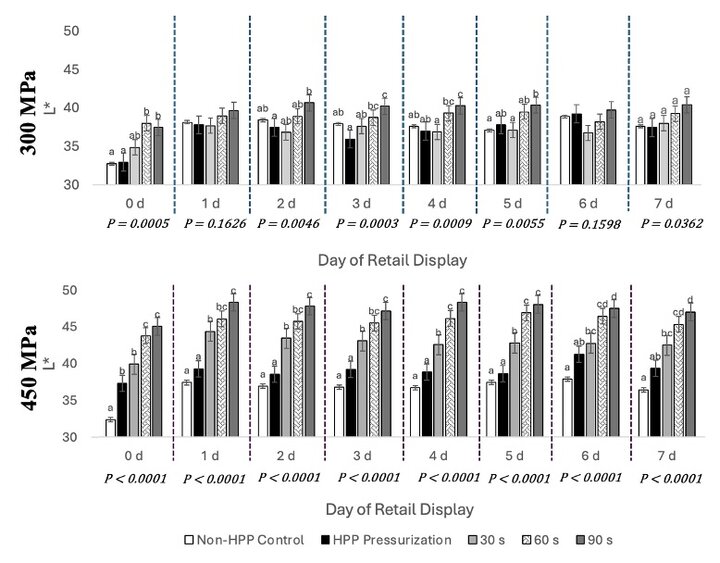
The observed effect on instrumental color following HPP treatment is shown in Figure 1. For lightness (L*) at 300 MPa, there was a holding time effect for L* (P ≤ 0.0362; Figure 2), except on days 1 (P = 0.1626) and 6 (P = 0.1598). The 90 s and 60 s treatments were lighter than the HPP Pressurization group for days 0, 2, and 3. By day 5, the 90 s treatment was lighter than the Non-HPP control and the 30 s groups. At 450 MPa, the 90 s and 60 s groups were lighter than the Non-HPP control on day 0 as well as the HPP Pressurization group for all remaining days (P < 0.0001; Figure 2). For redness (a*), there was a holding time effect at both pressures regardless of retail day (P ≤ 0.0019; Figure 3). At 300 MPa, the 90 s and 60 s treatments were more red than the HPP Pressurization group for days 1-7 as well as the Non-HPP control for days 3-5. Similarly, the Non-HPP control was less red than the 30 s, 60 s, and 90 s treatments for days 0-6 and the HPP Pressurization treatment on day 7. Furthermore, there was a holding time effect for yellowness (b*) at both pressures for all days (P ≤ 0.0155). The HPP Pressurization treatment was less yellow than the 60 s and 90 s groups for days 1, 2, 3, 4, and 6 in addition to the 30 s group on days 5 and 7 at the 300 MPa pressure. At 450 MPa, the 30 s, 60 s, and 90 s treatments were more yellow than the Non-HPP Control on all days and the HPP Pressurization group on days 0, 1, 3, and 4.


For subjective color, trained panelists evaluated steaks for visual color scores, paleness scores, and surface discoloration. At 300 MPa, the Non-HPP control, HPP Pressurization, and 30 s treatments had a darker lean color score than the 90 s treatment throughout the retail display (P ≤ 0.001). Furthermore, the non-HPP control steaks had the darkest lean, followed by the HPP Pressurization treatment, then the 30 s treatment and were all darker than the 90 s treatment for all days (P < 0.0001). In a similar way, the 90 s treatment had a paler lean than the Non-HPP control and HPP Pressurization treatments for all days in addition to the 30 s group except days 0 and 2 (P ≤ 0.0021) at 300 MPa. At 450 MPa, the 30 s, 60 s, and 90 s steaks were paler than the Non-HPP control and HPP Pressurization treatments. However, a holding time effect for discoloration was only found on days 5 and 6 at 300 MPa where the Non-HPP had greater surface discoloration than the 30 s, 60 s, and 90 s treatments.
Laboratory Analyses
For pH, there were no differences between treatments observed for either pressure at any measured day (P ≥ 0.1578). For thiobarbituric acid reactive substances (TBARS), used to measure lipid oxidation also known as rancidity, a holding time effect at 300 MPa was only observed on day 3 of retail display were the 90 s treatment had greater lipid oxidation than the Non-HPP control (P = 0.0109). Whereas at 450 MPa on day 0, the greatest lipid oxidation values were shared by the 90 s and 60 s treatments with the 30 s and HPP Pressurization groups falling intermediate and the Non-HPP control having the least lipid oxidation. For days 3 and 7, the 90 s, 60 s, and 30 s treatments had greater lipid oxidation than the Non-HPP control and the HPP Pressurization steaks (P < 0.0001). To measure tenderness, Warner-Bratzler shear force (WBSF) was measured, and differences were only observed on day 7 at 450 MPa where the 90 s steaks were less tender than the Non-HPP control and the HPP Pressurization groups (P = 0.0032).
Conclusions
At both 300 and 450 MPa, there was an increase in lightness and redness values. However, at 450 MPa, there may be excessive lightening, resulting in a pale appearance, in addition to increased lipid oxidation. The most promising results were observed at 300 MPa at holding times of 30 s or longer. These data also suggest that slightly longer holding times at 300 MPa should be investigated.
Copyright © 2025 The Board of Regents of the University of Nebraska. All rights reserved.