Authors: Esther VanOverbeke, High School Student, Waverly High School, Waverly, NE; Byron Chaves, Associate Professor and Food Safety Extension Specialist, Food Science and Technology, Lincoln.
Summary with Implications
Forty-eight million consumers in the U.S. get a foodborne illness each year; 128,000 are hospitalized and 3,000 die. Approximately one-third of those illnesses are related to animal-based foods, including meat. With meat-like alternatives being more readily available, it is critical to ensure these foods are handled appropriately to reduce foodborne illnesses. This project evaluated the food safety knowledge of extension professionals related to plant-based products and meat alternatives. A survey was distributed via the North Central Region Extension Center to Extension professionals (N=52). Most respondents, 58%, neither agreed or disagreed that plant-based meats/meat alternatives are microbiologically riskier than ground beef. The majority (83%) of respondents did not know the proper cooking temperature for at least one of the protein sources. Sixty-four percent of respondents indicated that they were interested in learning more about plant-based products/meat alternatives. Therefore, continuous education is needed for Extension professionals on safe food handling methods and practices for all products, including proper cooking temperatures.
Introduction
The Centers for Disease Control and Prevention (CDC) estimate that, annually in the United States, foodborne illnesses affect approximately 48 million people, with 128,000 hospitalizations and 3,000 deaths. Approximately one-third of these illnesses are related to animal-based foods, including meat. However, as new meat-like alternatives become more readily available, it is critical to ensure these foods are handled properly by consumers to reduce the risk of foodborne illnesses.
Extension professionals play a key role in educating consumers about safe food handling practices. The primary objective of this research was to assess the knowledge of extension professionals in the North Central region regarding the microbial safety of ground beef and meat alternatives, including plant-based products. A secondary objective was to evaluate their interest in learning more about food safety, regulatory and labeling of plant-based and meat alternatives. To address these aims, a survey was developed and distributed to the North Central Region Extension professionals to identify knowledge gaps and gauge interest in future educational programming.
Procedure
A 16-question computer-assisted survey about the perception of food safety of plant-based meat and meat alternatives as compared to ground beef was developed. The survey included the following questions types of questions: demographics (6 questions), questions relative to microbial risk relative to ground beef, open-ended questions asking the appropriate final cooking temperature of various protein sources, and their level of interest in receiving additional information/training about food safety related practices.
The survey instrument was developed using the Qualtrics software platform, and a secure survey link was used to provide access to the participants. The survey instrument was disseminated via the North Central Region Extension Center headquartered at Iowa State University to extension professionals (N = 52). Three reminders were sent, one each week, following the initial survey email. The survey was open for three weeks. Survey responses that did not complete at least one question beyond the demographics were excluded from the analysis. In total, 16 individuals responded to the survey resulting in a 30.77% response rate; 23.1% (n = 12) completed the entire survey. Survey responses, where appropriate, were analyzed as frequencies and compared using a Chi-squared test in Microsoft Excel (Microsoft 365) with statistical significance set at P ≤ 0.05.
Results
Demographic identifiers of respondents are presented in Table 1. Most of the respondents (75%) were female, represented eight states in the North Central Region, and had more than ten years of food safety experience (75%). Respondents were evenly split between age categories and years in their current position.
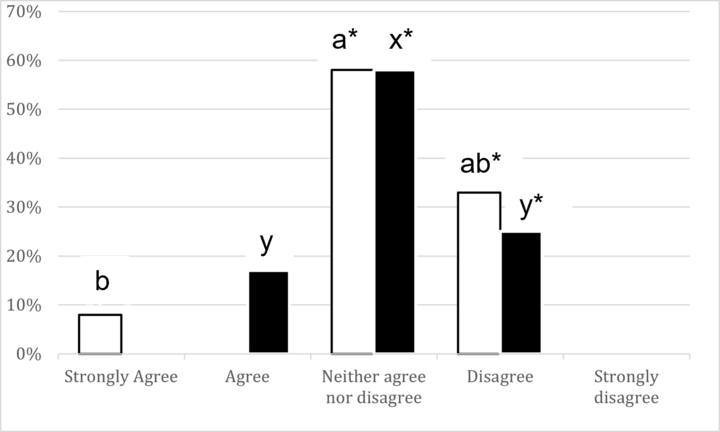
Figure 1 indicates the respondents’ level of agreement with the statement “plant-based or meat alternatives are microbiologically riskier than traditional ground beef patties.” Twelve respondents completed this question. Significantly more (P < 0.05) respondents selected the “neither agree nor disagree with” statement about both plant-based and meat alternatives. Responses for plant-based ranged from strongly agree to disagree and for meat alternatives ranged from agree to disagree.
Respondents were asked to identify the safe internal cooking temperature for chicken breast, ground beef patties, Impossible burgers, and beef steaks. Five of the 12 respondents completing the safe internal cooking temperature question responded with “I don’t know” (IDK) for at least one of the products. Temperature ranges identified for chicken breasts were 160°F-165°F with the most common response being 165°F (n = 8 responses). Temperature identified for ground beef patties ranged from 130°F to160°F with the most common response being 160°F (n = 6); for Impossible™ burgers 135°F-160°F with 160°F being the most common (n = 3); and for beef steaks 125°F-160°F with 145°F being the most common (n = 7).
Demographic Question | Category | Category % | Category | Category % | Category | Category % | Category | Category % |
| Gender | Male | 25.00 | Female | 75.00 |
|
|
|
|
| Age | 31-40 | 25.00 | 41-50 | 31.25 | 51-60 | 18.75 | 61-70 | 25.00 |
| Length of Time in Current Position | Less than 1 | 12.50 | 2-5 | 25.00 | 6-9 | 25.00 | 10+ | 37.50 |
| Years of Food Safety Experience | Less than 1 | 0.00 | 2-5 | 6.25 | 6-9 | 18.75 | 10+ | 75.00 |
Discussion and Conclusions
The data presented above give perspective on Extension food safety professionals as well as their understanding and/or perspective on the safe food handling of various meat products including plant-based patties and meat alternatives. As indicated in Figure 1, there was no statistical difference (P > 0.05) in the frequency of responses related to the microbiological risk of plant-based patties or meat alternatives compared to each other. Fewer respondents (P < 0.05) strongly agreeing that plant-based patties are riskier than ground beef as compared to respondents who said neither agree/nor disagree. Respondents indicated that they would expect plant-based meat to be similar in safety (P > 0.05) to meat alternative products.
While respondents recognize they are not aware of how the microbiological safety of ground beef and plant-based and/or meat alternatives relate to each other, they were less likely to acknowledge that they don’t know the safe internal cooking temperatures of various meat products. These results reflect the lack of current available literature surrounding the topic. Specifically, the USDA website (fsis.usda.gov) for safety food handling/cooking practices, information for ground beef, beef, bison, veal, pork, processed meats, rabbit, lamb, goat, fish, and poultry are easily accessible, but practices specifically for plant-based meats or meat alternatives are not outlined. However, the USDA does indicate protein source patties (ground protein of any source) should be cooked to 160°F. Still, the results from this survey show the responses for Impossible™ burgers (n = 5) and ground beef patties (n = 5) that were less than 160°F and the number of “IDK” responses (n = 4 and 1, respectively for Impossible™ and ground beef patties), potentially leading to a food safety issue if this guidance was given to a consumer or others involved in food preparation.
These results indicate a lack of awareness of food safety risks associated with the safety and cooking of meat and meat-alternatives in industry professionals. Extension professionals realize this as indicated by their interest in learning more not only about microbiological safety but also regulatory and labeling requirements of plant-based products and meat alternatives. There are knowledge gaps that exist, and there is a need for more education, even for extension professionals. Additional work can be done through Extension to help provide continual educational materials to various audiences to help prevent further incidence of foodborne illnesses caused by meat products and meat alternatives.
Copyright © 2025 The Board of Regents of the University of Nebraska. All rights reserved.