Authors: Kara A. Reynolds, Graduate Student; Leila G. Venzor, Research Technician; Ashley A. Hahn, Grace C. Johnson, Graduate Students; Jordan C. Wicks, Assistant Professor, Animal Science, Lincoln; Mary-Grace Danao, Associate Professor, Food Science and Technology, Lincoln; Ranjith Ramanathan, Professor, Oklahoma State University, Stillwater, OK; Gary A. Sullivan, Associate Professor, Animal Science, Lincoln.
Summary with Implications
This study evaluated the impact of high-pressure processing (HPP) on color, oxidative stability, and tenderness of tenderloins (psoas major) from cull cows to determine if HPP could enhance their marketability. Forty cull cow tenderloins were treated at two different HPP pressures and two different holding times, then assessed for instrumental and visual color, lipid oxidation, and Warner-Bratzler shear force during a 7-day stimulated shelf period. HPP increased initial lightness, especially at the highest pressure and longest holding time and improved redness initially. However, redness declined, and discoloration increased over the 7-day period, particularly after processing at higher pressures. Oxidation increased by day 3 in all pressure-treated samples. Tenderness did not improve nor worsen, and all cull cow samples remained tougher than the fed-beef controls. These results suggest that while HPP can initially enhance the visual appeal of cow tenderloins, product quality deteriorates quickly following higher pressures and longer hold times. Future research will evaluate if lower pressures and shorter hold times can better preserve color while limiting oxidation.
Introduction
Cull cows represent 10% of the U.S. beef industry. However, the inherent characteristics of their meat make it less marketable than beef from young finished cattle. The dark lean color and poor tenderness of cow meat limits consumer acceptance. Even so, the tenderloin (psoas major muscle) is still remarkably tender, and thus if the color of cow tenderloins could be improved, value would be added to cull cows. Recent work has shown that high-pressure processing can increase lightness and improve redness of lean in conventional high pH, dark cutting beef. While the mechanism by which this happens has yet to be fully elucidated, color changes occur in the absence of pH changes, suggesting that dark lean, regardless of pH, can be improved. Therefore, the objective of this experiment was to evaluate the effect that high-pressure processing has on color, oxidative stability, and tenderness of cull cow tenderloins.
Procedure
Forty cull cow tenderloins were obtained from a commercial abattoir and transported on ice to the UNL Loeffel Meat Laboratory. Tenderloins were faced on the posterior end (2.5 in), and an 11-in portion was collected. Tenderloin portions were vacuum packaged and assigned to one of five pressure (megapascal, MPa) (PSI) and holding time (s) treatments: 300MPa (43,511 PSI)-60s, 300MPa-90s, 375MPa (54,389 PSI)-60s, 375MPa-90s, and a non-HPP cow control. Additionally, eight USDA Choice tenderloins, serving as non-HPP fed beef controls, were procured from a commercial abattoir. Tenderloins underwent the assigned HPP treatments at the UNL Food Processing Center. Following HPP treatment, tenderloins were removed from their packaging and divided into 6 portions for subsequent analyses. Three 1.5-in steaks from each tenderloin were placed on Styrofoam trays and overwrapped with polyvinyl chloride film. Samples were subjected to a 7-day simulated retail display. Subjective color was observed once daily by a trained panel using three established scales: paleness (1–6; 1 being very dark red, 6 being very pale), Discoloration (1–6; 1 being 0% discored, 6 being 100% discolored), and color score (1–8; 1 being bleached red, 8 being very dark red). Instrumental objective color (L*, a*, b*) was assessed daily. Additionally, retail display steaks were frozen on days 0, 3 and 7 and stored at -30 °F for TBARS and pH analysis. One steak per sample was collected on day 0 for Warner Bratzler shear force (WBSF) and stored at -8 °F until time of analysis. Data were analyzed using the GLIMMIX procedure of SAS 9.4 (SAS Institute, Cary, NC, USA). Main effects of high-pressure processing treatments (pressure and time) were evaluated within day in a completely randomized design. Significance was determined at α=0.05.
Results
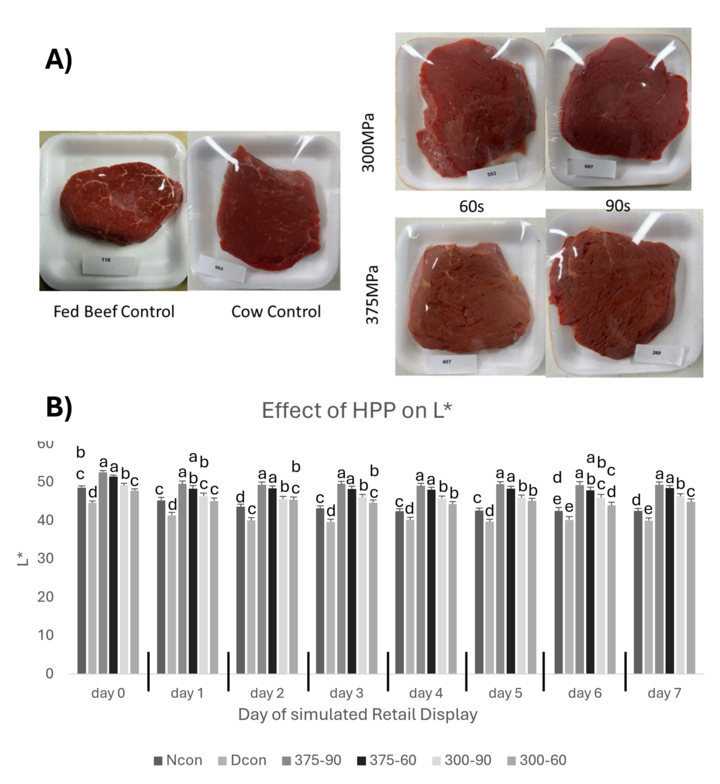
On all days during retail display, the 375MPa-90s treated cull cow tenderloins were lighter (P < 0.05) than all others except the 375MPa-60s treated tenderloins. The 300MPa-60s tenderloins had similar L* values to the fed beef controls on days 0, 1, 2, and 6. 300MPa-90s tenderloins were similar in L* to the fed beef control on day 0. The cull cow control tenderloins were among the darkest (lowest L* value) throughout the 7-day period (Fig. 1A and 1B; P < 0.05) but were similar in darkness to the fed beef control on day 6 (P < 0.05). For a* values (redness), the 375MPa-90s treated tenderloins were less red (P < 0.05) than the fed beef controls on all days except day 1. Compared to the non-HPP cull cow controls, 375MPa-90s tenderloins were redder on day 0, but their redness deteriorated over time with lower a* values on days 3 through 7 (P < 0.05). Both 375MPa treatments produced among the greatest b* values (yellowness) and were similar to b* values in the fed beef controls on days 1–7. The non-HPP cull cow control tenderloins were among the lowest in b* values (P < 0.05) but were similar to b* values for 300MPa-60s on days 1–7.
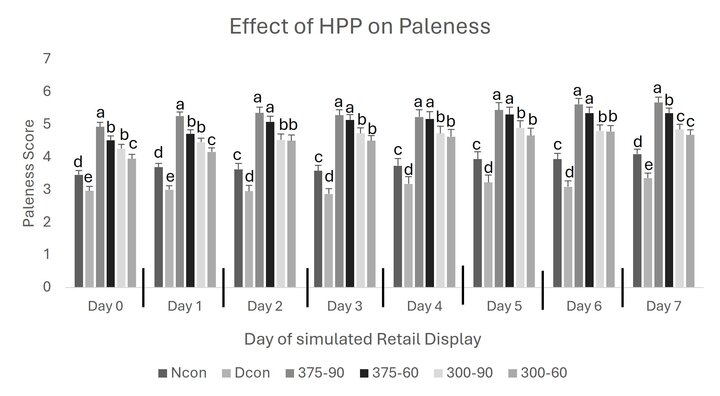
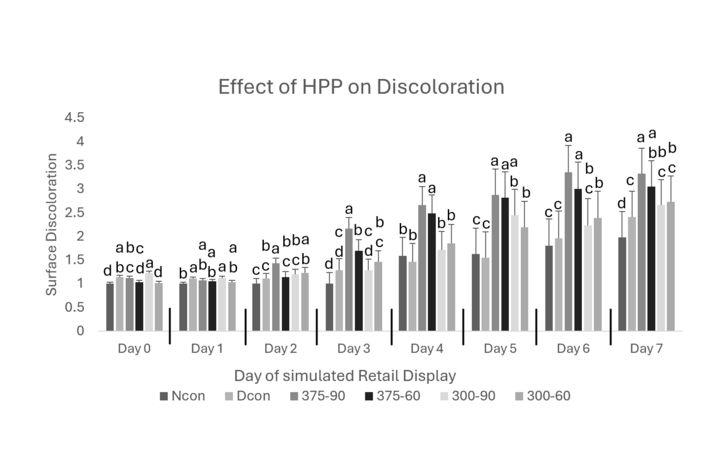
In color panel evaluations, the non-HPP cull cow control tenderloins always had the highest color score (darkest color) followed by the non-HPP fed beef controls. As HPP pressure and holding time increased, color scores declined. Similarly, the non-HPP cull cow control tenderloins had the lowest paleness scores (least pale), followed by the non-HPP fed beef controls (Fig 2; P < 0.0001). In general, as pressure and holding times increased, the paleness scores increased. The 375MPa-90s tenderloins were among the most discolored, beginning on day 2. The non-HPP cull cow controls were similar to 300MPa-60s tenderloins on all days except day 0 and 5 and were similar to 300MPa-90s tenderloins on all days except day 5 (Fig 3; P < 0.05). There were no differences in lipid oxidation among any tenderloin groups on day 0 of the retail display (P < 0.0001). On day 3, all pressure-treated cull cow steaks showed increased lipid oxidation compared to non-HPP fed beef and cull cow controls (P < 0.001). On day 7, both 375MPa-60s and 375MPa-90s tenderloins exhibited the highest lipid oxidation, while non-HPP fed beef and cull cow control tenderloins had the least (P < 0.0001). Tenderloin pH on day 0 was higher for non-HPP fed beef controls than for all other treatments except 375MPa-60s (P = 0.018). However, there were no differences among HPP-treated tenderloins. No differences in pH were identified among any tenderloin groups on days 3 or 7 (P = 0.489, P = 0.183, respectively). Additionally, all cull cow tenderloins had greater shear force values than the non-HPP fed beef control tenderloins (P = 0.007), but HPP treatment did not affect tenderness among cull cow tenderloins.
Conclusions
These findings suggest that high-pressure processing improves the initial lightness and redness of cow tenderloins which could improve consumer acceptability. However, higher pressures and longer hold times accelerate discoloration and oxidation during 7 days of shelf storage. Tenderness of cull cow tenderloins was unaffected by any regimen of high-pressure processing assessed in this study, and thus all cull cow steaks remained tougher than steaks from feedlot steers not exposed to high-pressure processing. However, the collective findings of this study show potential for HPP to enhance the visual appeal of cow tenderloins, and future research will determine if processing at lower pressures or shorter times results in better-maintained color stability and quality during retail display.
Acknowledgment
This was funded in part by the Beef Checkoff and the Nebraska Beef Council.
Copyright © 2025 The Board of Regents of the University of Nebraska. All rights reserved.