Authors: Shelley A. Curry, Melanie R. White, Ashley A. Hahn, Graduate Students; Dustin T. Yates, Associate Professor, Animal Science, Lincoln.
Summary with Implications
Heat stress in beef cattle triggers physiological and metabolic disturbances that compromise performance, health, and welfare. In this study, Red Angus heifers exposed to heat stress for 5 days exhibited elevated body temperatures, increased heart and respiration rates, and altered hematological and acid–base parameters. A commercial ω-3 polyunsaturated fatty acid (PUFA) dietary supplement failed to improve heat stress-reduced ribeye area or red blood cell parameters but did resolve the reduction in blood chloride concentrations, which is consistent with restoration of electrolyte balance and hydration under heat stressed conditions. These results indicate that ω-3 PUFA supplementation offers some supportive benefits during sustained heat exposure, presumably due to their anti-inflammatory and membrane-stabilizing properties. Supplementing anti-inflammatory nutrients like ω-3 PUFA represents a promising nutritional strategy that could be integrated into broader heat mitigation plans. Planned follow-up studies will assess the effects of long-term supplementation on performance. Implementing such approaches may provide producers with management options for maintaining performance and animal welfare during inevitable environmental heat stress.
Introduction
Heat stress is the longest-standing and most persistent challenge for US livestock production, causing an estimated $2.4 billion in annual economic losses for the beef industry alone. Climate experts predict that the frequency and severity of heat events will continue to increase, posing a growing threat to beef producers in the US and worldwide. With temperatures projected to increase by approximately 0.5 °F per decade over the next twenty years, the risks to sustainable and profitable animal agriculture are expected to intensify. Prolonged exposure of beef cattle to heat stress triggers a series of biological disruptions, including elevated core body temperatures, increased respiratory and heart rates, altered immune function, reduced feed intake, and diminished growth and carcass quality. These effects not only reduce meat production and profitability but also raise important concerns about animal welfare. In response, nutritional strategies have gained attention as a promising approach to alleviating the impacts of heat stress. In particular, dietary supplementation with ω-3 polyunsaturated fatty acids (PUFA) has shown potential due to their anti-inflammatory effects and ability to modulate immune and metabolic responses. This study aimed to evaluate whether daily supplementation with a commercial ω-3 PUFA product could reduce the negative effects of heat stress in Red Angus heifers. We hypothesized that ω-3 PUFA supplementation would mitigate key physiological indicators of heat stress, which are linked to poor health and performance outcomes. Ultimately, this research seeks to inform practical on-farm dietary interventions that enhance resilience and productivity in heat-stressed cattle.
Procedure
Red Angus heifers (BW = 533 ± 27 lb.) were selected from the university-owned beef herd at ENREEC in Mead, NE. Heifers were halter-broken and acclimated to stanchions under thermoneutral conditions (66 °F, 15% relative humidity). Heifers were then randomly assigned to an environmental condition: a) heat stress (104 °F, 35% relative humidity) or b) thermoneutral (66 °F, 15% relative humidity) conditions for 5 days. Heat-stressed heifers were also randomly assigned to receive ω-3 PUFA calcium salt (420 mg/kg/day; Strata, Virtus Nutrition) or a placebo. Heat-stressed ω-3 PUFA-supplemented heifers were treated for 10 days prior to the initiation of heat stress. Thermoneutral controls also received placebo supplements. After the initiation of heat stress, thermoneutral controls were pair-fed to match the average daily intake per body weight of the heat-stressed heifers. Blood samples were collected via jugular venipuncture on day -10 (i.e., 10 days prior to heat stress), day 0 (i.e., just prior to heat stress), day 2, and day 4 of heat stress exposure. Differential white blood cell counts were performed using a veterinary hematology analyzer. Body composition was assessed at the beginning and end of the study using ultrasound imaging and body weight measurements. Physiological parameters, including heart rate, respiration rate, and rectal temperature, were recorded daily. Data were analyzed as an ANOVA using the mixed procedure of SAS 9.4 (SAS Institute, Cary, NC, USA) with repeated measures where appropriate. Significant differences for all analyses were identified by a P-value of < 0.05, and tendencies were indicated by P-values between 0.05 and 0.10. All data are presented as least squares means ± standard errors.
Results
Physiological Parameters
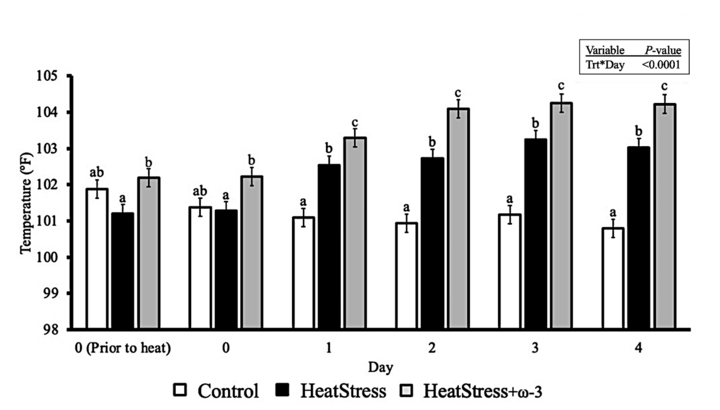
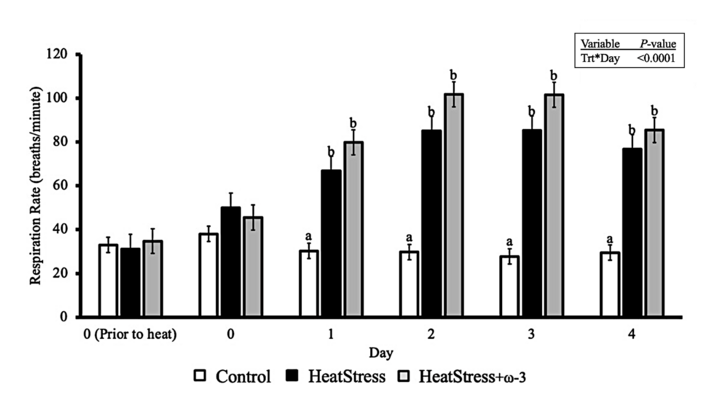
Heat stress in unsupplemented and ω-3 PUFA-supplemented animals exhibited elevated (P < 0.05) heart rates and respiration rates throughout the study compared to controls, which is consistent with an increased thermoregulatory burden. ω-3 PUFA-supplemented heat-stressed heifers exhibited the highest average heart rate (61.7 ± 1.1 bpm) compared to unsupplemented heat-stressed heifers (52.3 ± 1.0 bpm) and controls (46.8 ± 1.6 bpm), indicating no effect from inflammatory mitigation. While an increased heart rate is expected under heat stress, the observed heart rates remain within the normal range for cattle. Cardiac function is highly responsive to the adrenergic system, which is elevated during heat stress and causes heart rate to rise. Since anti-inflammatory agents do not directly antagonize adrenergic responses, they may not immediately affect cardiac responsiveness. Respiration rates did not differ among groups prior to initiation of heat stress, as expected (Figure 1). The exacerbation of respiratory effort under heat stress was obvious in supplemented and unsupplemented animals, as respiration rate increased (P < 0.05) by 34 – 75% once heat stress commenced. Supplemented and unsupplemented heat-stressed heifers both exhibited elevated (P < 0.05) body temperatures compared to controls once heat stress was initiated (Figure 2), but the magnitude of this increase varied by day. Following initial heat stress (day 0), ω-3 PUFA-supplemented heat-stressed heifers had the highest (P < 0.05) body temperatures, followed by unsupplemented heat-stressed heifers, with control heifers exhibiting the lowest temperatures. This pattern remained consistent throughout the heat-stress period, potentially due to hematological responses. Water intake was approximately 35% greater (P < 0.05) in supplemented and unsupplemented heat-stressed heifers compared to controls, consistent with increased sweating and other natural evaporative cooling mechanisms.
Hematological Responses
Circulating white blood cells, lymphocytes, monocytes, and granulocytes did not differ among groups. Hematocrit was reduced (P < 0.05) in unsupplemented heat-stressed heifers (31.0 ± 0.6 %) compared to controls (32.5 ± 0.5 %). An even greater reduction (P < 0.05) was observed in ω-3 PUFA-supplemented heat-stressed heifers (27.7 ± 0.7 %), suggesting hemodilution. This condition is characterized by increased water retention in the bloodstream, which results in diluted red blood cell concentrations. Hemodilution may serve as a physiological response to heat stress by enhancing blood flow and supporting heat dissipation under compound stress conditions. ω-3 PUFA-supplemented heat-stressed heifers also had notably lower (P < 0.05) hemoglobin and red blood cell concentrations compared to unsupplemented heat-stressed heifers and controls. Reduced hemoglobin and red blood cell concentration indicate a decreased oxygen-carrying capacity, which may contribute to fatigue and lethargy, prompting the cardiovascular system to increase blood flow to maintain oxygen delivery.
Acid–Base and Blood Gas Metrics
Blood lactate concentrations and blood pH did not differ among groups throughout the study, suggesting the absence of an anaerobic shift that is observed with longer durations of thermal hypoxia. Circulating carbon dioxide, bicarbonate concentrations, and base excess likewise did not differ among groups, which indicates a reasonably healthy metabolic state. Core blood oxygen metrics, including total and hemoglobin-bound O₂, remained statistically unchanged. No differences were observed in blood Na⁺, K⁺, or Ca2+ concentration among groups. Blood Cl- concentrations tended to be reduced (P < 0.10) in unsupplemented heat-stressed heifers (115.4 ± 3.9 mM) compared to controls (126.9 ± 1.7 mM) and ω-3 PUFA-supplemented heat-stressed heifers (125.6 ± 2.7 mM), which may indicate a shift in electrolyte balance due to enhanced fluid loss through sweating or panting, or renal compensation. Nevertheless, the rescue by ω-3 PUFA supplementation suggests that dietary ω-3 PUFA supplementation supports electrolyte homeostasis under heat stress.
Performance Traits
Heat stress reduced (P < 0.05) ultrasound-estimated ribeye area in supplemented (6.3 ± 0.2 in2) and unsupplemented (5.6 ± 0.2 in2) heifers compared to controls (6.7 ± 0.2 in2) after one week. No differences were observed among groups for 12th rib fat thickness or ribeye depth.
Conclusions
This study demonstrates that heat stress imposes substantial physiological and hematological burdens on beef heifers, characterized by elevated body temperatures, cardiovascular and respiratory strain, and alterations in blood chemistry and immune function. Supplementation with a commercial ω-3 PUFA product did not mitigate core heat stress responses, such as body temperature and respiration rate. However, it did contribute to the stabilization of acid–base balance, supported immune modulation, and facilitated thermoregulatory processes. Notably, supplemented animals maintained stable blood chloride levels, suggesting improved electrolyte balance and a hemodilution response to heat stress, thereby improving blood flow and supporting thermoregulation. Although moderate, the observed effects of ω-3 PUFA align with the mechanistic potential of ω-3 PUFA to reduce systemic inflammation and promote physiological resilience. Therefore, ω-3 PUFA supplementation shows limited but targeted benefits for heat-stressed cattle. Integrating anti-inflammatory nutraceuticals into nutritional management may offer producers a practical tool to support animal health and productivity under rising thermal stress conditions.
Acknowledgment
This study was supported by funding from USDA-NIFA and Nebraska Agricultural Research Division.
Copyright © 2025 The Board of Regents of the University of Nebraska. All rights reserved.