Authors: Melanie R. White, Shelley A. Curry, Ashley A. Hahn, Graduate Student; Jessica L. Petersen, Ty S. Schmidt, Dustin T. Yates, Associate Professor, Animal Science, Lincoln.
Summary with Implications
Heat stress throughout the summer and into the fall is a persistent hurdle for growing and finishing cattle in Nebraska. Minimizing the impact of heat on growth and well-being of cattle is critical to the productivity and profitability of beef production. This project aimed to evaluate the effect of an anti-inflammatory dietary supplement, ω-3 polyunsaturated fatty acids (ω-3 PUFA), on physiological indicators of stress during a 4-day moderate-intensity heat challenge. Heat stress elevated core body temperature and respiration rates as expected but did not impact circulating inflammatory biomarkers. Heart rate variability measurements indicative of adrenergic stress and reduced oxygen-carrying capacity in the blood were observed in heat-stressed steers. However, ω-3 PUFA supplementation improved most of these health indicators. These results indicate that ω-3 PUFA supplementation can benefit the well-being of cattle experiencing heat stress. The planned follow-up work will determine the impacts on growth performance.
Introduction
Reduced growth rates and poor feed efficiency during heat events make managing heat stress a major hurdle for cattle producers. These deficits occur due to physiological changes that are poorly understood but appear to include adrenergic signals from the adrenal gland and sympathetic nervous system. These systems release chemical messengers called catecholamines (e.g., adrenaline, noradrenaline) that engage stress responses comparable to the fight-or-flight response. Greater adrenaline signaling occurs to compensate for other changes in the blood during heat stress, including abnormal blood oxygen and increased white blood cells and inflammatory cytokines. Interleukin-6 (IL-6) and tumor necrosis factor-α (TNFα) are cytokines that alter body functions to reduce heat production, sacrificing growth to maintain overall well-being. Developing methods to preserve cattle well-being while maintaining efficient growth in stressed cattle is critical for maintaining productive and profitable beef systems. Targeting inflammation using potent anti-inflammatory nutrients such as ω-3 polyunsaturated fatty acids (ω-3 PUFA) is a promising option for mitigating heat stress-induced physiological responses that can compromise growth and well-being. This study evaluated the efficacy of supplementing steers with ω-3 PUFA during a 4-day moderate-intensity heat challenge on indicators of stress and inflammatory tone.
Procedure
Animals and Experimental Design
Commercial Red Angus-crossbred steers (594 ± 12 lb) were randomly assigned to one of three experimental groups: thermoneutral control conditions (n = 12), heat stress conditions (n = 12), or heat stress conditions with daily ω-3 PUFA supplement as an intervention (n = 12). Steers assigned to receive the intervention were fed 0.420 g/kg Ca2+ salts of ω-3 PUFA (Strata, Virtus Nutrition LLC) once per day before feeding, beginning two days prior to initiation of heat stress. Heat-stressed steers were housed at 87ºF and 31% relative humidity (Temperature-Humidity Index: 77) for 4 consecutive days. Control steers were pair-fed to the average daily intake of heat-stressed steers. Rectal temperatures were taken twice daily, and respiration rates were recorded daily.
Blood Analysis
Jugular blood samples were collected two days prior to initiation of heat stress (day -2), just prior to initiation of heat stress (day 0), and on days 2 and 4 of heat stress. Total white blood cells, lymphocytes, monocytes, granulocytes, hematocrit, and hemoglobin were measured with a HemaTrue Veterinary Hematology Analyzer. Plasma was isolated and commercial ELISA kits were used to determine circulating TNFα and IL-6.
Heart Rate Variability
Heart rates and heart rate variability metrics for each steer were collected with a Polar H10 Heart Rate Sensor and external band with electrodes. The band was positioned around the thoracic cavity just below the scapula. Ultrasound gel was used as couplant. The KubiosHRV phone app was used to quantify heart rate, RMSSD (an indicator of parasympathetic tone), parasympathetic nervous system index, and sympathetic nervous system index in 2 consecutive 3-minute measurements.
Statistical Analysis
Data were analyzed using the mixed procedure of SAS 9.4 with repeated measures to analyze the effects of experimental group, day, and the interaction of group by day, with steer as the experimental unit. Best-fit statistics were used to select the most appropriate covariance structures. Significant differences for all analyses were identified by a P-value of ≤ 0.05, and tendencies were indicated by P-values of ≤ 0.10. All data are presented as ls means ± standard errors.
Results
Core Body Temperature and Respiration Rate
Body temperatures did not differ among groups prior to initiating heat stress but were greater (P < 0.05) for both unsupplemented and supplemented heat-stressed steers for the duration of the 4-day heat stress period (Figure 1A). Similarly, respiration rates did not differ among groups prior to initiation of heat stress but were greater (P < 0.05) for both unsupplemented and supplemented heat-stressed steers than for controls thereafter (Figure 1B).

Hematology and Inflammatory Cytokines
Plasma IL-6, plasma TNFα, total white blood cells, lymphocytes, monocytes, and granulocytes did not differ among groups. Hematocrit was less (P < 0.05) for unsupplemented heat-stressed steers than for controls but was recovered for ω-3 PUFA-supplemented heat-stressed steers. Hemoglobin concentrations tended to be less (P < 0.10) for unsupplemented heat-stressed steers than for controls but was recovered for ω-3 PUFA-supplemented heat-stressed steers. Results are summarized in Table 1.
| Blood Component | Control | Heat Stress | Heat Stress+ω-3 PUFA* |
| (n = 12) | (n = 12) | (n=12) | |
| Total White Blood Cells, cells/μL | 8.28 ± 0.44 | 7.47 ± 0.44 | 8.23 ± 0.42 |
| Lymphocytes, cells/μL | 5.97 ± 0.31 | 5.21 ± 0.31 | 6.01 ± 0.30 |
| Monocytes, cells/μL | 0.71 ± 0.05 | 0.68 ± 0.05 | 0.69 ± 0.05 |
| Granulocytes, cells/μL | 1.62 ± 0.23 | 1.58 ± 0.20 | 1.53 ± 0.17 |
| Hematocrit, % | 27.27 ± 0.55 a | 24.97 ± 0.76 b | 26.92 ± 0.55 a |
| Hemoglobin, g/dL | 10.55 ± 0.20 x | 9.99 ± 0.20 y | 10.48 ± 0.20 x |
| Plasma IL-6, pg/mL | 11.01 ± 0.53 | 11.08 ± 0.48 | 11.92 ± 0.51 |
| Plasma TNFα, ng/mL | 0.21 ± 0.01 | 0.22 ± 0.01 | 0.24 ± 0.01 |
| a, b P ≤ 0.05 x, y P ≤ 0.10 | |||
| *Ca2+ salt of ω-3 PUFA supplemented at 0.42g/kg BW/day | |||
Heart Rate Variability
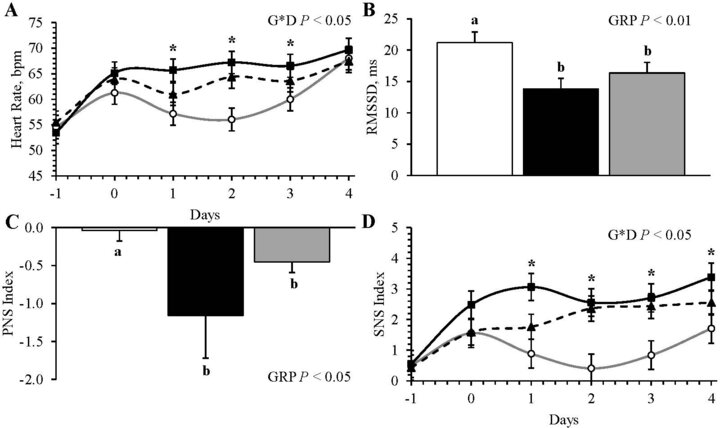
Heart rates did not differ among groups prior to heat stress. In unsupplemented heat-stressed steers, heart rates were greater (P < 0.05) than controls for all days of the heat-stress period except day 4. In ω-3 PUFA-supplemented heat-stressed steers, heart rates were normal on day 1, increased (P < 0.05) just like in unsupplemented heat-stressed steers on day 2, partially improved (P < 0.05) on day 3, and back to normal on day 4 (Figure 2A). RMSSD (Figure 2B) and PNS index (Figure 2C) were less (P < 0.05) for both unsupplemented and ω-3 PUFA-supplemented heat-stressed steers than for controls throughout the study. SNS index did not differ among groups on prior to initiation of heat stress but was greater (P < 0.05) for unsupplemented heat-stressed steers on all days after heat stress was initiated. For ω-3 PUFA-supplemented heat-stressed, SNS index was normal on day 1, elevated (P < 0.05) just like in unsupplemented heat-stressed steers on days 2 and 3, and partially improved (P < 0.05) on day 4 (Figure 2D).
Conclusions
Heat stress negatively impacts the productivity and profitability of feedlot cattle in part by inducing stress responses that negatively impact growth. In this study, a moderate heat challenge did not elicit the same major response from indicators of inflammation that are commonly seen with heat stress events of longer duration or greater severity. However, the modest heat stress in this study did compromise indicators of oxygen-carrying capacity and elicited adrenergic stress that was apparent in altered heart rate variability. Indeed, reduced tone from the “calming” division of the nervous system (i.e., the parasympathetic nervous system index), and increased tone from the “fight or flight” division of the nervous system (i.e., the sympathetic nervous system index) and the adrenal gland all indicate that heat stress exposure caused steers to shift toward a more stressed physiological state. Such physiological states require more energy to maintain basic function and thus leave less energy for growth. Moreover, if sustained for long periods, these stress states will result in dysfunction of metabolic and homeostatic systems responsible for well-being. Although we previously established the role of inflammation in chronic heat stress, the lack of robust improvement associated with the anti-inflammatory supplement in the present study shows that other stress factors elicit these specific responses to moderate environmental heat. Conversely, improvements in oxygen-carrying capacity attributable to supplementation of anti-inflammatory ω-3 PUFA may indicate low-grade inflammation still existed during moderate heat stress and thus still represents a viable intervention target to improve heat stress outcomes.
Acknowledgment
This research was funded by the USDA-NIFA AFRI Foundational grant 2020-67015-30825 and Hatch Multistate Research capacity funding program (accession 1011055, 1009410).
Copyright © 2025 The Board of Regents of the University of Nebraska. All rights reserved.