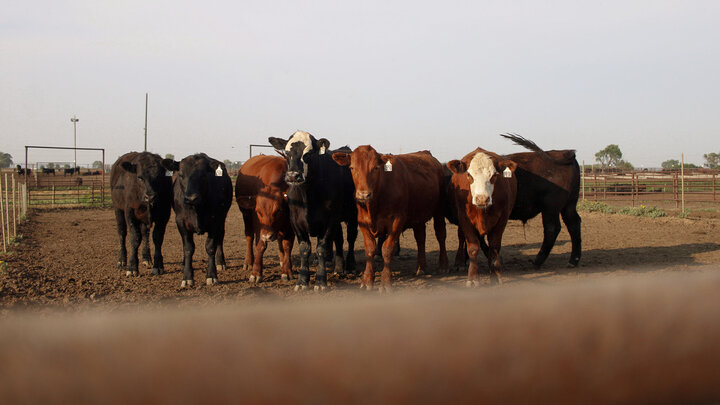
Methane is produced by dairy and beef cattle when feeds are digested (rumen fermentation) in the stomach (rumen). Through the digestive process methane is belched from the mouth of the animal into the environment. There are also small amounts of methane produced from storage of livestock manure. An example would be feedlot lagoons that catch and store runoff from pens.
Agriculture’s contribution to greenhouse gas emissions is about 10%. About 4% of the 10% is in the form of direct methane production, mostly from cattle. Methane from cattle accounts for 25% of the 11% of the methane in the atmosphere.
The University of Nebraska began its journey in measuring methane and researching mitigation strategies in beef cattle in 2014 (2014 NE Beef). The research included an ionophore in the ration to alter volatile fatty acid (VFA) production. Ionophores increase the VFA propionate at the expense of butyrate and acetate. The response of methane production due to treatment was variable. In addition, it was concluded that getting exact measurements of methane production is not easy and it is important to get the measuring techniques developed. Calculations used to determine amounts need to be refined. After 2014, research on methane production in beef cattle continued. Buildings were retrofitted, and state-of-the-art instrumentation was purchased to measure methane production. Methane production from ruminants has been measured in different settings including cattle in an open pasture, which is really difficult as methane detecting instrumentation needs to be placed to account for environment conditions like wind direction.
In 2012, the University began to study the use of energy in dairy cattle rations by using a technique known as indirect calorimetry. In a headbox system, a pump gently pulls air from inside the “box” capturing the gases the cattle breathe out. Scientists then measure carbon dioxide and methane produced by the animal and also measure how much oxygen is consumed. Together these measures can then be used to calculate how much heat the animal produces. Using this system, researchers can feed cows different diets and track where the energy from their food goes. About 30% of the energy a dairy cow consumes is used to produce milk. The largest amount of energy that doesn’t go toward production is lost in feces (30–35%). Other major energy losses include heat (around 30%), methane (about 5%), urine (around 3%), and tissue growth (about 1%). Because this system allows investigators to precisely measure methane, it has been used to test new feed additives that reduce enteric methane production in dairy cattle.
In 2024, a team of research and extension faculty from the University of Nebraska and U.S. Meat Animal Research Center received a $5 million grant to research more sustainable dairy and beef production systems. The team is studying the interrelationships among animal genetics, the gut microbiome and nutrition and methane production. The goal of the research is to develop tools and management practices that lower methane emissions from dairy and beef cattle. The ultimate goal of this research is to investigate ways to establish a rumen environment early in the life of dairy and beef cattle that produces less methane without having a negative impact on normal growth and production.
In 2025, researchers at UNL received a $2.3 million grant to study cattle with lower methane production. The grant was from Bezos Earth and the Global Methane Hub. The project aims to create genetic tools to help identify and breed cattle that emit less methane without sacrificing performance. Studies have shown that some cattle emit less methane than others and that these traits are heritable. The goal is to produce genetic selection tools to enable breeders to select animals that produce less methane.
The following are key points of understanding related to methane:
- Greenhouse gasses (GHGs) trap heat from the sun from getting back into the atmosphere.
- Methane is one of three primary greenhouse gases.
- The greenhouse gas methane is 11% of all greenhouse gases in the atmosphere.
- Beef and dairy cattle account for 25% of the methane in the atmosphere.
- Methane traps heat better than any other greenhouse gas.
- Methane has a half-life of 9 to 12 years.
- Because of the half-life of methane, it is not sustained in the atmosphere for a long period of time as compared to other greenhouse gases.
- Small reductions in methane production result in big reductions in heat trapping ability of greenhouse gases.
- Reducing methane as a greenhouse gas will help reduce the earth’s warming.
- 10% of GHGs come from Agriculture.
- Of the 10% of the GHGs, livestock (mainly ruminants) account for 4%, mostly from livestock methane production.
- Cattle (ruminants) produce methane by belching it from their mouth, titled enteric fermentation.
- Methane is important to the well-being of cattle.
- Some cattle produce less methane than others.
Why research methane production in dairy and beef cattle?
- To reduce the methane contribution of cattle as a greenhouse gas.
- To determine mitigation of methane that is economical and sustainable.
- Help producers make informed decisions when considering methane mitigation strategies.