Ruminants like beef and dairy cattle, sheep, goats, deer, and other animals have a rumen. The rumen is a large fermentation vat that has billions of microbes. These microbes survive without air, meaning the rumen is anaerobic. Microbes digest cellulose from forage-rich diets that provide nutrients to the animal.
Rumen fermentation is a process that converts ingested feeds into energy and protein sources to sustain the life of the animal. More specifically, microbes in the rumen take feed/food and break them down for the microbes to use first and finally for the animal to use. When feeding ruminants, it is important to know that feeding microbes is important. This digestive process enables ruminant animals to eat plants that otherwise would not be digested. The result of the rumen fermentation process is methane. Methane is belched from the rumen out of the mouth into the atmosphere. Methane is one of the three major greenhouse gases.
The term enteric fermentation is the process in the rumen of cattle where anaerobic microbes called methanogens decompose, and ferment feeds present in cattle’s digestive tract producing nutrients for the host animal to absorb to meet their nutrient requirement. Methanogens also produce methane in the rumen of cattle.
All sources of methane have one thing in common, microbial methanogenesis. In other words, all sources of methane have an environment that has microbes called methanogens that produce methane.
It would seem logical, if it is known that methanogens are the microbes that produce methane, why not eliminate the methanogens from the rumen environment of cattle? It is not that easy. Cattle have methanogens in the rumen early in life and are always a member of the rumen microbiome. If the methanogens are eliminated, they seem to always re-establish themselves as a member of the rumen microbiome. It is interesting that some cattle at birth have less of their microbiome as methanogens compared to others.
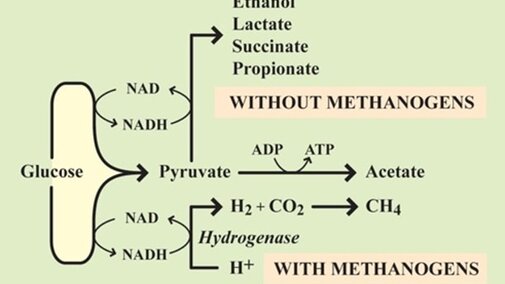
Figure 1 illustrates several components. Methanogens in the rumen are involved in a process of producing energy for the “host” animal. The host animal would be a calf, cow, bull, or other ruminants. The graph illustrates how energy is produced for the host animal at the cellular level. Energy at the cellular level is from the production of ATP and NADH. The graph illustrates how that process is accomplished with methanogens in the rumen. The unintended consequence of eliminating methanogens in the rumen is loss of energy for the host animal at the cellular level. The loss of energy at the cellular level impacts animal well-being.

Overall, methanogens in the rumen of cattle are important for the health and well-being of the animal. Even though it is known that the production of methane can be interrupted in some reaction process in the animal, it is not fully understood the side effects of impacting the well-being of the animal. Again, methanogens are in the rumen of cattle at a very young age and the rumen wants to maintain a population of methanogens. Interestingly, some calves have less methanogens in the rumen as compared to others. While methanogens in the rumen contribute to methane emissions, they also play a vital role in the animal’s digestion and energy production. Overall, these scenarios highlight the challenges of reducing emissions without negatively affecting animal health and productivity.