Greenhouse gases (GHG) are molecules in the Earth’s atmosphere that allow heat from the sun to pass through to the surface while restricting heat from escaping back through the atmosphere, leading to a net warming effect on the climate. The name ‘greenhouse gas’ originated from the process first observed in glass greenhouses. The glass lets sunlight and solar heat into the “greenhouse” but does not let heat escape as easily, creating a desirable environment for growing plants during cold weather. Greenhouse gases similarly trap heat produced by the sun and produce a warming effect on a global scale.
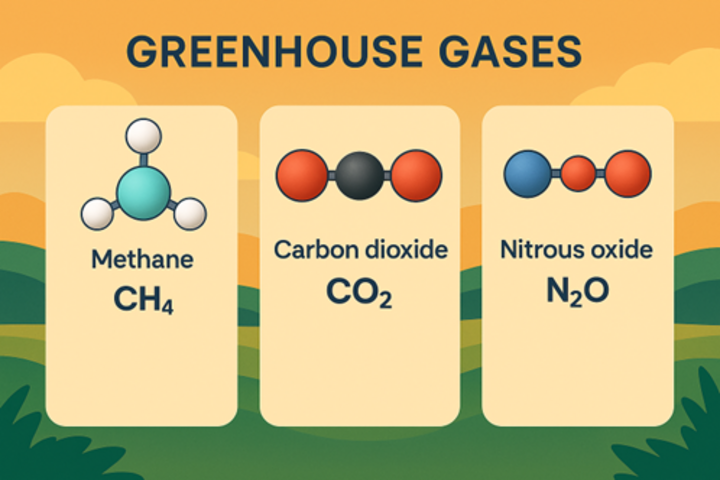
The primary greenhouse gases are carbon dioxide (CO2), methane (CH4), and nitrous oxide (N2O). It’s important to note that these compounds are naturally present in the atmosphere at small concentrations and are not problematic when in balance. Plants take in carbon dioxide from the atmosphere during photosynthesis, as part of the biological carbon cycle, and when this carbon returns to the atmosphere as carbon dioxide (natural respiration and decomposition processes), balance is maintained. The concerns about GHG relate to contributions from human-influenced (referred to as ‘anthropogenic’) activities, which have increasingly tipped things out of balance, resulting in increasing GHG concentrations in the atmosphere.
Carbon dioxide accounts for about 80% of GHG emissions. Carbon dioxide enters the atmosphere through burning fossil fuels (coal, natural gas, and oil), decomposition of solid waste, and other organic materials, and because of certain chemical reactions (e.g., cement production). Methane accounts for about 11% of GHG emissions. Methane is emitted during production and transportation of coal, natural gas, and oil and from agriculture. Nitrous oxide accounts for about 6% of GHG emissions. Nitrous oxide is emitted during agricultural land use, and industrial activities; combustion of fossil fuels and solid waste; and treatment of wastewater.
Each of these gases can remain in the atmosphere for different amounts of time, ranging from a few years to thousands of years. All gases remain in the atmosphere long enough to become mixed, meaning that the concentration in the atmosphere measured at one location is roughly the same all over the world.
Half-life is defined as the time needed for an element or compound to decrease to half of its original value. The atmospheric half-life of carbon dioxide is thousands of years. In comparison, the atmospheric half-life of the methane is about 9 to 12 years, meaning that after 9 to 12 years, half of the methane released today into the atmosphere will have been degraded into carbon dioxide (effectively removed). The shorter half-life of methane means it has less “staying ability” in the atmosphere as greenhouse gases. However, methane is more potent than other GHGs, meaning that it is more effective at trapping heat.
Methane produced by both beef and dairy cattle as well as other ruminants such as sheep, deer, and goats is called “enteric methane”. This methane is produced when feeds are digested in the rumen by microorganisms through fermentation. During the natural process of rumen fermentation, methane is belched out through the mouth and into the atmosphere. Enteric methane’ represents about 4% of the 10% GHGs coming from agriculture.