The Vector
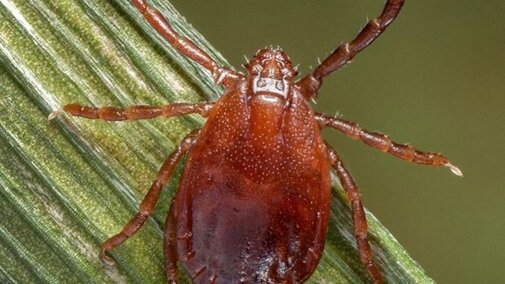
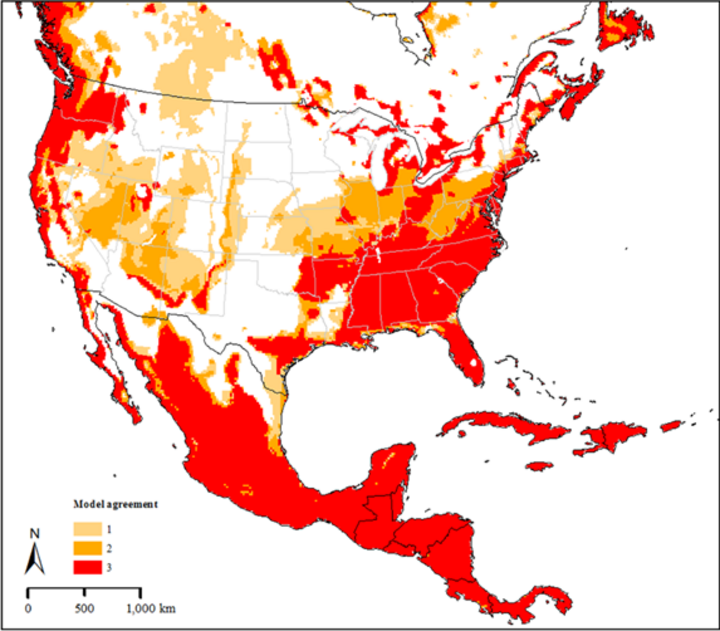
The Asian longhorned tick (ALHT) (Haemaphysalis longicornis) is native to the Eastern Hemisphere and was first detected in the United States at a port of entry in New Jersey in November 2017. Detections have since spread west across numerous states with recent detections reported in the surrounding states of Iowa, Kansas, and Missouri. Adult ticks can be physically transported to new areas; however, establishment of populations require specific environmental conditions that include amenable climate, vegetation, and humidity. Therefore, detection of a small number of ticks does not necessarily indicate an established tick population. It’s unclear whether portions of Nebraska would be suitable for ALHT populations to become established. In 2018, researchers published a report in Nature that modeled where tick suitable environmental conditions exist throughout the United States to predict the potential spatial distribution of the ALHT. ALHT detections since then fit well with the study’s predicted spatial distribution over time. Note that of the three models developed, two models predict portions of both western and eastern Nebraska as being suitable for ALHT establishment (see map below). Two other groups have done similar modeling studies and do not include Nebraska as a suitable location for ALHT distribution. As of March 2026, there have been no confirmed detections of ALHT within the state of Nebraska.
Tick Identification
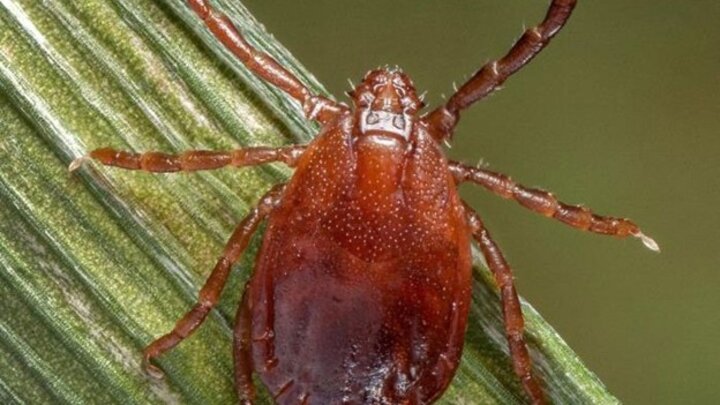
ALHT are roughly 2 mm in size (similar to a sesame or mustard seed) prior to a bloodmeal and light brown to burnt orange in color. If ALHT is suspected, the Nebraska Veterinary Diagnostic Center offers preliminary tick identification. For accurate tick identification, proper tick removal, storage, and transport is important.
- Ticks should be removed by grasping them at the base of the mouthparts, as close to the skin of the host as possible.
- Slowly and forcefully pull the tick away from and perpendicularly to the skin to prevent tearing of the mouthparts.
- Mouthparts are typically important for tick identification.
- Ticks should be placed in sealable containers (e.g., glass vials, plastic vials) with alcohol, preferentially 70-90% ethanol.
- Ticks do not have to be refrigerated or frozen.
- The more ticks submitted- the better, since prevalence is not known.
- Vials should be sent using ambient temperature, packing with absorbent material and in a plastic bag to avoid spillage through the packaging, and placed in a rigid box.
- Samples can be submitted using our ruminant submission form with a test request for Parasite ID.
- Mailing labels can be ordered and printed directly from our website.
- Samples may be required to be forwarded to USDA for confirmatory identification.
Bovine Theileriosis
The ALHT is a carrier of Theileria orientalis, a protozoal pathogen that causes the syndrome bovine infectious anemia. There are no approved treatments for these infections, so tick control and biosecurity are essential to disease prevention. The Nebraska Veterinary Diagnostic Center offers multiplex PCR testing for Theileria orientalis and Anaplasma marginale, two common causes of infectious anemia. PCR testing can be conducted on whole blood samples submitted in EDTA tubes (purple top) or fresh spleen, with pooling available for up to 5 samples.
Theileria orientalis infection promotes the destruction of red blood cells resulting in anemia causing decreased oxygen delivery to tissues. As such, the clinical signs associated with bovine theileriosis are nonspecific and variable. Icterus (i.e. jaundice) is one of the more common clinical signs observed in severely affected animals, but most animals show no or very minimal clinical signs. However, increased morbidity and mortality events are commonly reported, particularly in calves and at times of stress such as weaning. Infected animals become lifelong carriers, serving as a reservoir for other AHLT and making iatrogenic transmission to naïve animals possible via needles or other mechanisms that can transfer blood from one animal to another.
Bovine theileriosis is a notifiable disease in Nebraska and requires prompt reporting to the Nebraska Department of Agriculture. To date, Theileria orientalis has been detected in specimens from imported feedlot animals at several locations in Nebraska. In each case, the animals originated in states from the southeast United States where the AHLT is well established and bovine theileriosis is very common. The effect of theileriosis on feeder calf health is poorly understood, but the risk of anemia during times of high stress in positive animals may contribute to increased morbidity and/or mortality in the feedyard. According to a recent newsletter, Kansas State Veterinary Diagnostic Laboratory has seen a dramatic increase in percentage of PCR positive detections for Theileria orientalis. The most severe cases also had high respiratory morbidity and mortality in calves. Since the ALHT is not currently established in Nebraska, the risk of disease in native cow/calf herds is likely exceedingly low. However, if the ALHT were to become established in parts of Nebraska in the future, the risk of theileriosis in native animals would increase.
Current and Planned Bovine Theileriosis Efforts in Nebraska
- UNL School of Veterinary Medicine and Biomedical Sciences (SVMBS), Nebraska Extension, and other groups are working with stakeholders to communicate and research topics around bovine theileriosis in Nebraska including management, diagnostic testing, and prevention strategies.
- Faculty at the Nebraska Veterinary Diagnostic Center and UNL School of Veterinary Medicine and Biomedical Sciences continue to work to understand current disease status and future risk in Nebraska, including surveillance for vector borne diseases such as Theileriosis in Nebraska in cow calf and feedlot sectors.
What to Do if You Suspect AHLT or Theileriosis
If you suspect bovine theileriosis in your animals, contact your herd veterinarian. If you suspect AHLT within Nebraska, contact the Nebraska Department of Agriculture at (402) 471-2351.
Additional Resources
- Nebraska Department of Agriculture (402) 471-235 https://nda.nebraska.gov/animal/diseases/bovine-theileriosis
USDA APHIS https://www.aphis.usda.gov/livestock-poultry-disease/cattle/ticks/asian-longhorned
Nebraska Veterinary Diagnostic Center (402) 472-1434
- Dr. Dustin Loy, NVDC Director and Veterinary Microbiologist
- Dr. Matt Hille, NVDC Pathologist and Extension Specialist
- Dr. Duan Loy, NVDC Veterinary Microbiologist
UNL School of Veterinary Medicine and Biomedical Sciences (402) 472-2952
- Dr. Roberto Cortiñas, Veterinary Parasitologist
Nebraska Extension (402) 762-4500
- Dr. Brian Vander Ley, Veterinary Epidemiologist and Extension Specialist
- Dr. Becky Funk, Extension Specialist
- Dr. Lindsay Waechter-Mead, Extension Educator and Nebraska BQA Director
References
- Raghavan RK, Barker SC, Cobos ME, Barker D, Teo EJM, Foley DH, Nakao R, Lawrence K, Heath ACG, Peterson AT. Potential Spatial Distribution of the Newly Introduced Long-horned Tick, Haemaphysalis longicornis in North America. Sci Rep. 2019 Jan 24;9(1):498. doi: 10.1038/s41598-018-37205-2.
- Pest Alert: Asian Longhorned Tick (Haemaphysalis longicornis). USDA APHIS. https://www.aphis.usda.gov/sites/default/files/alert-asian-longhorned-tick.508.pdf