Ruminants like beef and dairy cattle, sheep, goats, deer, and other animals have a rumen and the rumen contains microbes. Rumen fermentation is a process that converts ingested feeds into energy and protein sources. More specifically, microbes in the rumen take feed/food and break them down for the microbes to use and for the animal to use. When feeding ruminants, it is important to know that feeding microbes is important. This digestive process enables ruminant animals to eat plants that otherwise would not be digested. One result of the rumen fermentation process of feeds is methane. Methane is belched from the rumen into the atmosphere. Methane is one of the three major greenhouse gases.
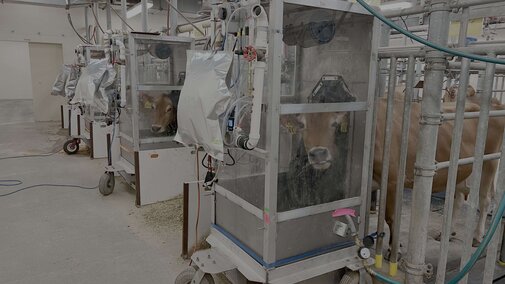
Measuring methane produced by cattle is not easy and is most accurate when environmental conditions can be completely controlled. Headboxes or small calorimetry chambers offer very precise measurements, and air flow in and out can be managed. The disadvantages are that only a few animals can be monitored at a time and animals need to be trained.
Small buildings can be retrofitted to measure methane produced by cattle. There is little to no training for the animals needed and animals are in a more normal environment. The retrofitted building set-up is not as precise as the head boxes, and control of the air exchange system is tricky. Also, fans in the building need to be calibrated for air exchange, and this is really tricky. It is not easy to retrofit a building with all the moving pieces that need to be calibrated.
Green feed systems can be used to measure methane produced by cattle. In this system, methane can be captured from many animals. Using this system, methane production can be captured in a pasture setting. A disadvantage of this system is that methane is captured in a small timeframe.
It is not easy to capture methane from cattle. The methane collection systems are expensive.
A small amount of methane is produced from cattle manure. Cattle manure decomposes and releases methane. Manure runoff from feedlot pens or dairy production pens is collected in lagoons. Manure collected in lagoons decomposes and a byproduct is methane. Digesters can be built on farms to reduce the methane produced by cattle manure. There are a number of different types of digesters. Anaerobic digesters hold manure in the absence of oxygen and are maintained so that methanogens, microorganisms that produce methane, grow. Manure digesters use microbes, heat, water, and physical agitation of the animal waste. The three main byproducts from the process are methane gas used as a renewable energy source, liquid manure that can be used for fertilizer, and solids that are dried that can be used in bedding for livestock. Digesters reduce methane release into the atmosphere that comes from manure.