What is Synchronization?
For decades, cattlemen have used artificial insemination (AI) and synchronization in beef and dairy herds. These time-proven techniques allow producers to use proven genetics by AIing with frozen semen and bring a large percentage of the cowherd into “heat,” or estrus, at the same time.
However, synchronization requires an approved protocol, following the schedule and hormones administration rate, but it does not always require AI. Several protocols allow producers to use their bulls (called “natural service”), thus reducing labor, AI technicians, and time.
Synchronization = Herd Benefits
Bulls + Synchronization = Herd Benefits
What are the benefits to the cowherd, if a producer decides to utilize a synchronization protocol while using natural service/bulls? If calves are sold at weaning, many cattlemen like the uniformity of those calves, since the calving occurs in a tighter window, the calves are usually closer in weight. Synchronization can also bring non-cycling heifers or cows into estrus, allowing for earlier calving- view article here.
Protocols for Natural Service and Herd Synchronization
The synchronization protocols for natural service can be found at: https://beefrepro.org/natural-service-protocols/
There are two protocols for CIDRS- one using 7 days and one using 14-days. Studies have shown that the 14-day CIDR protocol had higher pregnancy rates in heifers than the 7-day CIDR protocol. However, cows’ pregnancy rates were similar for both protocols.
Below are four examples of protocols when planning on using bulls for breeding.
Example 1. Fourteen Day CIDR- can be used on Cows & Heifers
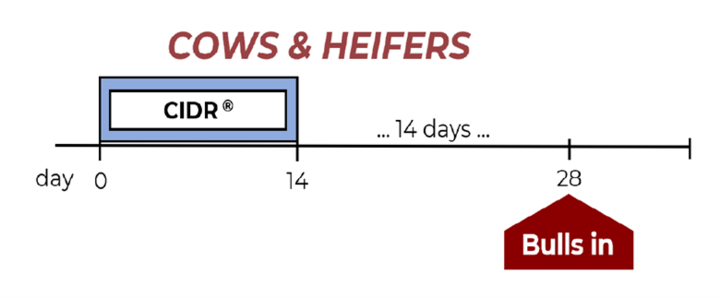
- Insert a CIDR for 14 days (Day 0 to Day 14).
- Remove the CIDR on Day 14.
- Wait for another 14 days (Day 14 to Day 28).
- Turn out bulls on Day 28.
Example 2. Seven Day CIDR- can be used on Cows & Heifers
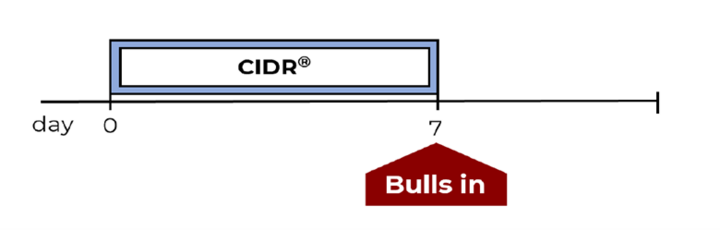
- Insert a CIDR for 7 days (Day 0 to Day 7).
- Remove the CIDR on Day 7.
- Also turn in bulls on Day 7.
Example 3. Prostaglandin Shot- can be used on Cows & Heifers
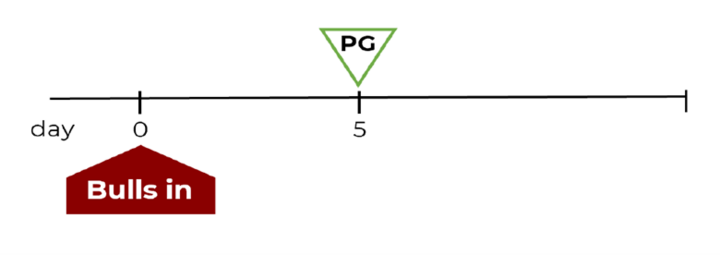
- Turn bulls out on Day 0.
- Five days later, give a shot of prostaglandin (PG) (on Day 5).
- For more details, read the article “Simple Synchronization of Cows - One Injection, One Time through the Chute, and Bull Breed.”
Example 4. MGA®- can be used on Heifers Only

- Start feeding the recommended daily dose of Melengestrol Acetate (MGA®) for 14 days (Day 0 to Day 14).
- Stop feeding MGA® on Day 14 and wait 14 days (Days 14 to 28).
- Turn bulls in on Day 28.
Considerations
- Do you have the time, skills, facilities, and budget to synchronize your cowherd? Research the protocols, talk with producers who do synchronize, and build the skills needed. Facilities, like portal panels and chutes can be rented, if your facilities are lacking.
- If feeding MGA® to heifers, make sure you feed in a bunk, so the animals get the recommended dose each day. Heifers on green grass may not eat the MGA® feed as well as heifers in a drylot situation.
- Because bulls will be breeding the cows, it is important to follow a synchronization protocol for natural service. These protocols stretch the herd’s estrus over 7-14 days, allowing the bulls to cover cows more easily.
- If you decide to use a synchronization protocol, plan ahead to order supplies, special feed (if feeding MGA to heifers), and utilize online synchronization calendars to ensure the timing is precise.
- Consider the bull-to-cow ratio. Research shows reduced conception rates when a 1:50 bull to cow ratio was used. However, no difference was seen in a 1:24 or 1:16 bull-to-cow ratio.
- Young bulls should have a lower bull-to-cow ratio, meaning younger bulls should be exposed to fewer cows than a more mature and experienced bull.
- Don’t forget to complete breeding soundness evaluations, 4-6 weeks before turning bulls out with the cowherd. Schedule an appointment to semen test your bulls with your veterinarian.
- Monitor bulls during the breeding season. Check to make sure bulls are “sound” and their feet, legs, and hips aren’t hurt. Also check that the sheath and penis are not swollen. Pull bulls that may be hurt and replace with sound, healthy bulls.
- If several bulls are turned out with one herd, studies show that the conception rate for each bull is not equal. One or two bulls may “dominate” and do the majority of the breeding.
- This question comes up when producers might lack the calving facilities or manpower during a blizzard- "if I synchronize my herd, will all the calves come at once?" Even cows timed AIed on the same day, calved over a 2-week interval. With synchronization, the calving window will be tighter than without, but should be spread out over several weeks.
References
- Reproductive Management Strategies to Maximize Production with Natural Service- Drs. G.A. Perry and J.C. Dalton.
- Beef Reproduction Task Force (website): https://beefrepro.org/
- Healy, V.M., G.W. Boyd, P.H. Gutierrez, R.G. Mortimer, and J.R. Piotrowski. 1993. Investigating optimal bull: heifer ratios required for estrus-synchronized heifers. J. Anim. Sci. 71: 291-297.
- Estrus Synchronization Recommendations for Artificial Insemination of Beef Heifers. https://extension.missouri.edu/publications/g2025