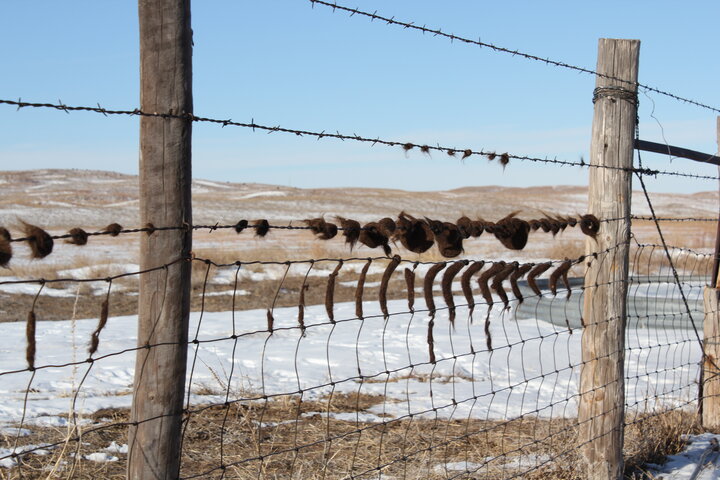
As we move from fall into early winter, producers should begin monitoring their cattle for signs of cattle lice. Cattle exhibiting hair loss, an unthrifty appearance, rubbing on fences or other objects, and the presence of hair on fences may be infested with lice (Figure 1).
Cattle lice thrive in cold conditions, with populations increasing in December and January, peaking in February. Lice are spread primarily through direct contact between animals. However, other conditions—such as natural shedding, poor nutrition, mite infestations, mineral deficiencies, photosensitivity, and disease—can mimic lice infestations.

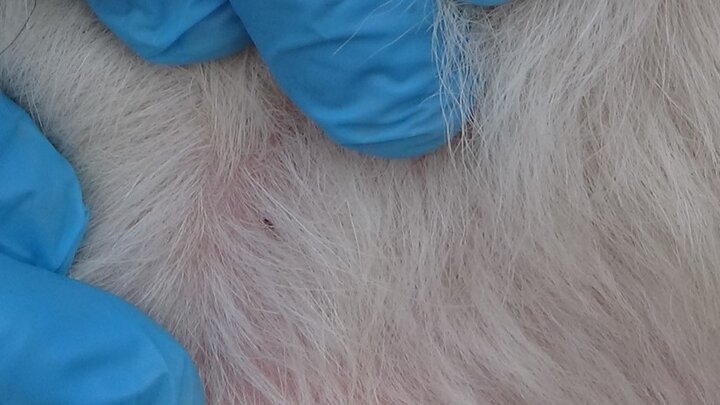
To confirm whether lice are the problem, restrain the suspect animal(s) in a chute and perform a two-handed hair parting (Figure 2) along the topline, withers, and face.
- 1–5 lice per square inch: low population (continue to monitor)
- 6–10 lice per square inch: moderate population (treatment is likely needed soon)
- More than 10 lice per square inch: heavy population (control treatment required)
Species of Cattle Lice in Nebraska
Nebraska cattle may host four different lice species, one biting (chewing) louse and three sucking lice species.
Biting or Chewing Louse – Bovicola (Damalinia) bovis
Commonly called the “little red louse,” this species feeds on hair, skin exudates, and surface debris. It is usually found on the shoulders, topline, and back, but as populations increase, they spread to the sides and sometimes the entire animal. Populations can increase rapidly since females can reproduce asexually, without requiring males.
Sucking Lice
These species feed on blood and can cause irritation, anemia, weight loss, and even death in severe cases.
- Short-nose cattle louse – Haematopinus eurysternus
The largest cattle louse (3–5 mm). Found mainly on older animals in the neck region, dewlap, back, and base of the tail. - Long-nose cattle louse – Linognathus vituli
About 2.5 mm long, this species is commonly found on the dewlap, shoulders, neck, and rump, spreading over the entire body at high densities. - Little blue cattle louse – Solenopotes capillatus
About 1–2 mm long, typically found in dense patches on the dewlap, muzzle, around the eyes, and neck. Heavy infestations can significantly reduce weight gain.
Impact on Cattle Performance
University of Nebraska and other studies have shown that heavy lice infestations can reduce weight gain by up to 0.21 lb./day. Calves receiving a higher nutritional plane exhibited lower lice populations and were less severely affected than calves fed at a maintenance level.
Treatment Options
Cattle louse control products fall into several categories:
- Animal sprays
- Non-systemic (contact) pour-ons
- Endectocides (systemic pour-ons or injectables)
Some non-systemic pour-ons require two applications for optimum lice control, at a 14-day interval. Systemic injectables are most effective against sucking lice, while systemic pour-ons control both chewing and sucking lice. For a list of current control products, please refer to (Table 1).
Important caution:
Avoid using systemic control products between November 1 and February 1. These may trigger a host–parasite reaction by killing developing cattle grubs while they are in the esophagus or spinal canal. Systemic products applied during fall weaning do not pose this risk. If a systemic product was not used during weaning, apply only non-systemic control products during the November–February period.
Timing and Management Considerations
Many producers administer an endectocide at weaning (late September or October) to control internal parasites, cattle grubs, and lice. While these applications may reduce lice populations, they often do not completely eliminate them, especially during an extended warm fall.
Producers using this strategy should closely monitor cattle during December through February. Newly purchased or additional animals should be examined and, if lice are present, treated and isolated before being introduced to the herd.
Insecticide Resistance Management
To maintain long-term effectiveness of lice control products, rotate between Insecticide Resistance Action Committee (IRAC) Mode of Action (MoA) groups. Repeated use of products from a single MoA group can lead to resistance and control failure. Rotate insecticide classes among animal sprays, dusts, pour-ons, and injectables as part of a sound resistance management program.
For additional information and current insecticide recommendations, visit:
👉 www.veterinaryentomology.org
Table 1. Control Products for Cattle Lice
Non-systemic - Group 3A
Synthetic Pyrethroid Pour-ons
Label Recommendation - One Application
- BOSS® - 5% Permethrin
- SABER™ - 1% Lambda-cyhalothrin
- StandGuard™ - 0.5% Gamma-cyhalothrin
- Ultra Boss® - 5% Permethrin + 5% PBO
- Ultra Saber™ - 1% Lambda-cyhalothrin + 5% PBO
Non-systemic Group 3A
Synthetic Pyrethroid Pour-ons
Label Recommendation – Two Applications
- BRUTE® - 10% Permethrin
- Cattle Armor™ – 1% Permethrin + 1% PBO
- CyLence® - 1% Cyfluthrin
- CYONARA™ PLUS (Martin’s®) 1% Lambda-cyhalothrin + 5% PBO
- Permectrin™ CDS – 7.4% Permethrin + 7.4% PBO
- PERMETHRIN 1% SYNERGIZED (Martin’s®) 1% Permethrin + 1% PBO
- PROZAP® Insectrin CS – 7.4% Permethrin + 7.4% PBO
- Synergized DeLice® 1% Permethrin + 1% PBO
IGR + Synthetic Pyrethroid Pour-on – Group 15 + 3A
- Clean-UP™ II – 3% difluenzuron + 5% permethrin
- Not rain fast
- Ovicidal activity
- Has worked well as rescue treatment
IGR + Synthetic Pyrethroid Pour-on – Group 15 + 3A
- Prozap Protectus Pour-on – 3% diflubenzuron + 2.5% Piperonyl Butoxide +
- Not rain fast
0.5% Lambda-cyhalothrin
- Ovicidal activity
- Has worked well as rescue treatment
IGR + Synthetic Pyrethroid Pour-on – Group 15 + 3A
- Inhibitor™ Pour-on - 3% diflubenzuron + 2.5% Piperonyl Butoxide +
0.5% Lambda-cyhalothrin
- Not rain fast
- Ovicidal activity
Endectocide Pour-ons
Systemic - Group 6
- Agri-Mectin® - 5 mg ivermectrin/ml, 1 ml/22 lb. body wt.
- Rain fast 6 hours
- 48-day slaughter withdrawal period
- Generic (Agri Labs)
- Bimectin®- 5 mg ivermectrin/ml, 1ml/22 lb. body wt.
- Rain fast 6 hours
- 48-day slaughter withdrawal period
- Generic (Bimeda®)
- CYDECTIN® - 5 mg moxidectin/ml, 1ml/22 lb. body wt.
- Not affected by rain
- No slaughter withdrawal period
- Elanco Animal Health
- DECTOMAX® - 5 mg doramectin/ml, 1ml/22 lb. body wt.
- Not affected by rain
- 45-day slaughter withdrawal period
- Protected cattle against long-nose for 42 days, and chewing lice for 77 days
- Zoetis Animal Health
- DECTOGARD™ - 5 mg doramectin/ml, 1 ml/22 lb. body wt.
- Not affected by rain
- 45-day slaughter withdrawal period
- Protected cattle against long-nose for 42 days, and chewing lice for 77 days
- Aurora Pharmaceutical, Inc.
- Doramectin Pour-on for Cattle – 5mg/ml1ml/22 lb. body wt.,
- Not affected by rain
- 45-day slaughter withdrawal period
- Protected cattle against long-nose for 42 days, and chewing lice for 77 days
- Durvet, Inc.
- EPRINEX® - 5 mg eprinomectin/ml, 1ml/22 lb. body wt.
- Zero slaughter and milk withdrawal period
- Do not apply to areas of the backline covered with mud or manure
- Boehringer Ingelheim Animal Health
- EPRIGARD™ - 5 mg eprinomectin/ml, 1ml/22 lb. body wt.
- Zero slaughter and milk withdrawal period
- Do not apply to areas of the backline covered with mud or manure
- Generic (Aurora Pharmaceutical, Inc.)
- Eprizero® - 5 mg eprinomectin/ml, 1ml/22 lb. body wt.
- Zero slaughter and milk withdrawal period
- Do not apply to areas of the backline covered with mud or manure
- Generic (Norbrook, Inc.)
- IVOMEC® - 5 mg ivermectin/ml, 1ml/22 lb. body wt.
- 48-day slaughter withdrawal period
- Rain fast in 6 hours
- Chewing lice control for 56 days after treatment
- Boehringer Ingelheim Animal Health
- IVERMECTIN POUR-ON FOR CATTLE - 5 mg ivermectin/ml, 1ml/22 lb. body wt.
- 48-day slaughter withdrawal period
- Rain fast in 6 hours
- Generic (Duravet)
- Noromectin® - 5 mg ivermectin/ml, 1ml/22 lb. body wt.
- 48-day slaughter withdrawal period
- Rain fast in 6 hours
- Generic (Norbrook, Inc.)
- ProMectin® B - 5 mg ivermectin/ml, 1ml/22 lb. body wt.
- 48-day slaughter withdrawal period
- Rain fast in 6 hours
- Generic (VEDCO, INC.)