Grasshoppers have long been recognized as a periodic problem across Nebraska rangelands. The most damaging pasture species are typically found in areas receiving less than 30 inches of annual precipitation—conditions that characterize nearly two-thirds of western Nebraska. When consecutive years of drought occur, the risk of grasshopper outbreaks increases substantially. In recent years, southwestern, south-central, and western Nebraska have experienced below-normal precipitation, creating conditions favorable for rangeland grasshopper population increases.
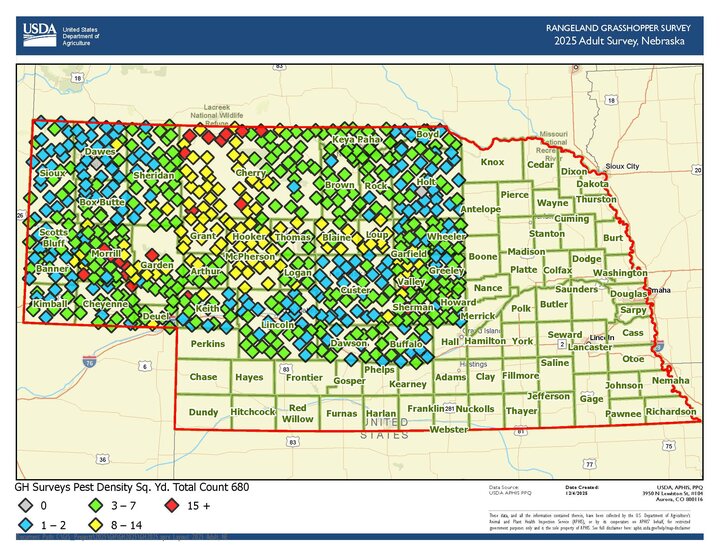
The 2026 Adult Rangeland Grasshopper Density Map (Figure 1) identifies counties surveyed and population densities recorded at sampling sites. Six counties reported sampling sites with average adult grasshopper densities exceeding 15 per square yard (red diamond designation). These data are based on the 2025 adult survey and serve as a strong indicator of potential grasshopper pressure for the summer of 2026.
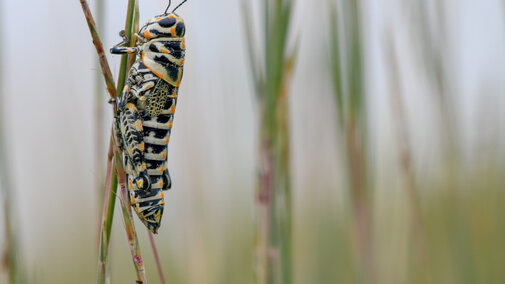
Approximately 50 grasshopper species occur on Nebraska rangeland; however, fewer than 10 species typically reach economically damaging levels and account for roughly 95% of total forage loss. Grasshoppers reduce forage availability through direct feeding on leaves and stems and by cutting vegetation during feeding.
Life Cycle
Grasshoppers develop through three stages: egg, nymph, and adult. Most species overwinter as eggs in the soil. Egg hatch typically begins when soil temperatures reach 50–55°F. Newly hatched nymphs resemble small adults but lack wings and reproductive structures. As they grow, nymphs undergo a series of molts typically four to six, with five being most common.
Development time from hatch to adult generally ranges from 30 to 50 days, depending on temperature and forage quality. Warm, dry conditions can accelerate development and increase survival, contributing to population buildup.
Impact
Grasshoppers are highly efficient consumers of forage, capable of consuming up to 50% of their body weight daily. Population density directly influences forage loss:
- Grasshoppers consume up to 50% of their body weight daily
- An average of 2.7 grasshoppers per square yard equals approximately 12,971 grasshoppers per acre.
- At 69.7 grasshoppers per square yard, daily forage consumption is equivalent to that of one grazing cow.
Economic thresholds for treatment typically range from 8 to 40 grasshoppers per square yard, depending on control costs, expected forage production, and livestock value. When forage conditions are already limited due to drought, lower thresholds may justify treatment.
Monitoring
As late spring approaches, livestock producers and land managers should begin monitoring pastures for emerging grasshopper populations. Early detection is critical for effective management.
One of the most practical field methods for estimating grasshopper density is the square-foot method:
- Select sampling sites throughout the pasture, spaced approximately 50–75 feet apart.
- At each site, visualize a one-square-foot area on the ground.
- Walk toward the area and count all grasshoppers within or jumping out of the square.
- Repeat this process 18 times across the pasture.
- Total the number of grasshoppers counted and divided by 2 to estimate the number per square yard.
Regular monitoring allows producers to make timely and economically sound management decisions before populations reach damaging levels.
Control
A grasshopper IPM program called Reduced Agent and Area Treatment (RAATs) was developed by researchers at the University of Wyoming to improve grasshopper control in pastures and rangeland. This chemical control strategy utilizes the insecticide Dimilin 2Lwhich interferes with the molting process of grasshoppers. Dimilin 2Lis applied in alternating strips reducing application costs by 50 to 60% and reducing the amount of insecticide used by 65 to 70% compared to conventional broadcast treatments. The RAAT system provides up to 85% control, depending upon rate of growth of the forage, the size of the grasshoppers and the coverage obtained. Treatments should be applied when grasshopper nymphs are small, averaging less than ¾ of an inch in length.
Establishing Economic Treatment Points
Rangeland thresholds of 25-30 grasshoppers per square yard, 3rd and 4th instar nymphs per square yard, or ¾ of an inch in length are guidelines.
- Use simple sampling methods: The square-foot method provides a quick and effective way to estimate grasshopper densities in the field.
- Timely decisions matter: Early detection and management can reduce forage loss and help protect pasture productivity.
Before making an application of a control product, please access the website Bulletins Live! Two (BLT) a web-based application to access Endangered Species Protection Bulletins. These bulletins contain enforceable pesticide use limitations that are necessary to ensure a pesticide’s use will not harm a species listed as threatened or endangered.