This article was originally featured in Progressive Cattle.
Corn silage is often used as a primary ingredient in growing cattle diets. The crude protein content of corn silage is approximately 6.5 to 8.5%, which is primarily in the form of rumen degradable protein (RDP).
Rumen degradable protein is digested in the rumen and utilized by the microbes for protein synthesis. Rumen undegradable protein (RUP) escapes rumen degradation and is digested in the small intestine. The true protein that is absorbed in the small intestine as a combination of microbial crude protein and RUP is referred to as metabolizable protein (MP). Cattle use MP to perform metabolic processes involved in maintenance and growth. When MP requirements are not met due to inadequate RUP, growth performance is limited.
Corn silage is low in RUP, with approximately 16% of the crude protein value consisting of RUP (2022 Nebraska Beef Cattle Report). In order to meet the MP requirements of growing cattle, distillers grains is often supplemented due to its high RUP content (63% of crude protein). Previous research has shown improved performance of growing calves fed distillers grains in silage-based diets (2011 Nebraska Beef Cattle Report).
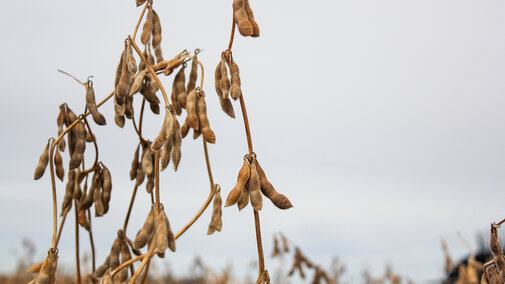
When distillers grains are unavailable or cost prohibitive, soybeans may be a viable alternative protein source. Soybeans are high in crude protein (around 40%). While raw soybeans are relatively low in RUP (20% of crude protein), roasting soybeans can increase the RUP content to 50% or more.
The University of Nebraska-Lincoln recently conducted a study to compare feeding raw, whole or roasted soybeans to modified distillers grains at three inclusion levels (7%, 14%, and 21% of diet dry matter) in silage-based growing diets. All diets were formulated to meet or exceed the MP requirements of growing heifers and were fed for 84 days.
Feeding modified distillers grains resulted in the greatest intakes and gains, while feed efficiency was improved for heifers fed roasted soybeans. When comparing inclusion levels, gains were greatest when each protein source was included at 21% of the diet, and feed conversion was generally improved by including the protein source at 21% of the diet dry matter compared to an inclusion of 14%. Ending weight increased linearly for heifers fed increasing inclusions of modified distillers grains and raw, whole soybeans. The improved performance associated with the 21% inclusion level of each protein source may reflect an energy-driven response since protein requirements were met.
Overall, soybeans can be a good source of protein and fat in growing cattle diets. The higher RUP content of roasted soybeans offers a performance advantage compared to feeding raw, whole soybeans in silage-based growing diets. However, depending on price and availability, both roasted and raw, whole soybeans may be competitive alternatives to feeding distillers grains without compromising growing cattle performance.
This article is a summary of the 2026 Nebraska Beef Cattle Report, “Effect of Feeding Whole Soybeans, Roasted Soybeans, or Distillers Grains in Silage-Based Growing Beef Diets.”