Virtual fencing’s greatest value may be its ability to make grazing management practices that require frequent fence movement or additional cross-fencing more practical. Over the past few years, we have conducted three studies evaluating virtual fencing in different grazing situations. The studies addressed three questions:
- Can virtual fencing replace polywire when strip grazing?
- Does moving a virtual boundary daily improve forage use compared with weekly moves in stockpiled forage?
- Can two groups of cattle be kept separate when only virtual boundaries exist between them?
Together, the results provide a better picture of what virtual fencing can do.
How Does Virtual Fencing Work?
In a virtual fencing system, cattle wear GPS-enabled collars. Producers draw boundaries using a computer or mobile device, and those boundaries are transmitted to the collars. As an animal approaches a virtual boundary, the collar provides an audio cue. If the animal continues toward the boundary, it receives an electrical pulse. Once cattle learn what the audio cue means, most turn away before receiving a pulse. Training is an important part of the process. In all three studies, cattle were trained for 10 days to 2 weeks before being placed into the experimental grazing pastures. All pastures had physical perimeter fences. Therefore, these studies evaluated virtual fencing as a tool for creating interior grazing boundaries, not as a replacement for a secure perimeter fence.
What Does Containment Rate Mean?
Containment in these studies was calculated as the percentage of recorded GPS locations that occurred within the assigned virtual paddock. Containment rate is useful for evaluating how effectively the system controlled where cattle spent their time. Even in situations with high containment rates, cattle will still sometimes cross the virtual boundary, thus producers should not use virtual boundaries in locations where a brief crossing could create a serious safety problem.
Can Virtual Fence Replace Polywire for Strip Grazing?
A two-year study compared three methods of grazing stockpiled sorghum-sudangrass:
- Continuous grazing
- Strip grazing using temporary polywire
- Strip grazing using virtual fencing
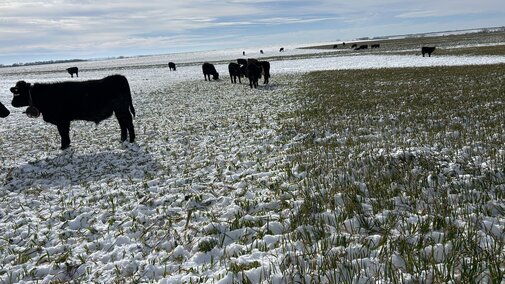
Each year, 60 growing steers were assigned to six paddocks. New forage was provided to the strip-grazed cattle approximately every nine to ten days. The cattle were also supplemented with dried distillers grains because of the relatively low quality of the mature, stockpiled forage. Average daily gain was similar among treatments, averaging 1.39 lb/d. However, strip grazing allowed the same number of cattle to graze for the same amount of time while using fewer acres. There was essentially no difference between polywire and virtual fence. Carrying capacity averaged 3.46 AUM/ac for polywire and 3.44 AUM/ac for virtual fence, compared with 2.82 AUM/ac under continuous grazing. Depending on the year, strip grazing increased grazing capacity by 13% to 24%.
The benefit came from controlling cattle access to the forage. Virtual fencing allowed for controlled access to forage using a phone/mobile device rather than having to physically move a polywire. Cattle in the virtual-fence treatment were within their assigned grazing area an average of 99.2% of the time, based on GPS locations recorded by the collars.
In addition, the collar’s solar battery performed reliably during winter grazing, with no issues related to low battery levels or failure of charging under typical Nebraska winters.
Are Daily Moves Better Than Weekly Moves?
Once we knew virtual fencing could be used effectively for strip grazing, the next question was whether increasing the frequency of forage allocation would improve utilization.
In a study using stockpiled oats, 72 steers were assigned to one of three treatments:
- Continuous grazing
- Weekly forage allocations using virtual fence
- Daily forage allocations using virtual fence
The oats had been planted after corn silage harvest, and grazing began in November. During the first 72 days, average daily gain did not differ among treatments (2.04 lb/d). However, the cattle continuously grazing the entire paddock used up their available forage, while the strip-grazed treatments still had ungrazed oats remaining. The weekly and daily groups were able to return to the field and graze for an additional 19 days. Across the full grazing period, strip grazing increased carrying capacity 40% compared with continuous grazing (2.28 vs. 1.64 AUM/ac). The improvement was a result of reducing forage trampling losses. Importantly, moving the virtual boundary daily did not provide an additional benefit over moving it weekly. Animal performance, forage utilization, and carrying capacity were similar between the two strip-grazing frequencies.
Containment was very good while slightly greater with weekly allocations than daily allocations at 99.53% versus 98.50%. More frequent boundary changes also resulted in more interactions between the cattle and the virtual fence system. This is likely due to the narrowness of the strips provided, which in some cases was as little as 6 ft in the daily move groups. More management intensity was not better when grazing this stockpiled forage, and weekly allowance seemed to capture the grazing efficiency benefits of strip grazing.
Can Virtual Fence Keep Two Groups of Cattle Separate?
Most virtual-fence research has involved managing a single group of cattle. However, producers may also want to use virtual boundaries to separate different classes of cattle within the same pasture. This could, for instance, allow heifers to be grazed ahead of cows and select the best forage first.
To evaluate the ability of virtual fence to keep two groups of cattle separate, 39 trained steers were placed in either an isolated virtual paddock with no visual contact with other groups of cattle or in a virtual paddock adjacent to another group of cattle. In the co-fenced treatment, there was no physical cross-fence between the two groups. However, the groups were not placed directly against the same virtual line. An approximately 80-ft buffer separated their respective virtual boundaries.
Containment exceeded 99% in both situations, averaging 99.96% when another group was present in the adjoining paddock and 99.68% when cattle were isolated. The presence of neighboring cattle also did not increase the number of audio cues or pulses cattle received. Across the study, cattle responded to the audio cue approximately 96% of the time. In other words, they received only about one pulse for every 20 audio cues.
The overall results indicate that trained cattle can be managed as separate groups within a shared pasture using virtual boundaries. This could create opportunities for implementing leader-follower grazing without constructing multiple physical cross-fences.
The Bottom Line
Across these three studies, virtual fencing created effective interior boundaries and allowed cattle to be managed in ways that would normally require additional physical fencing and labor.
The research suggests that:
- Virtual fencing can be as effective as polywire for strip grazing.
- Strip grazing can increase carrying capacity without reducing individual-animal performance.
- Weekly forage allocations may be sufficient, as daily movements did not provide additional benefits in the oats study.
- Separate groups of trained cattle can be managed in adjacent virtual paddocks, although crossings can still occur.
These studies did not determine whether virtual fencing will pay for itself on every operation. Its value will depend on the number of cattle, acres managed, existing fencing infrastructure, labor availability and the management changes producers are willing to make. The greatest return will likely occur when the technology allows producers to implement a grazing strategy they would not otherwise have the labor or fencing infrastructure to use.
What’s Next?
We are currently working with The Nature Conservancy using virtual fencing as a tool to create effective fire breaks. Additionally, several studies are being considered based on what we learned from the research mentioned above. These include using virtual fencing to manage a lead-and-follower system and separating cows that have calved from those that are still pregnant.