Introduction
Advancements in genetics, management, and nutrition have allowed the U.S. beef industry to sustain—and even increase at times—total beef production with a progressively smaller cowherd (Figure 1). Put simply, each breeding cow now produces offspring that generate more beef each year.

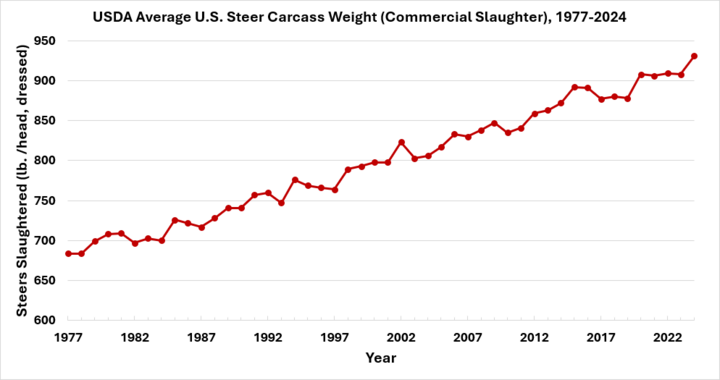
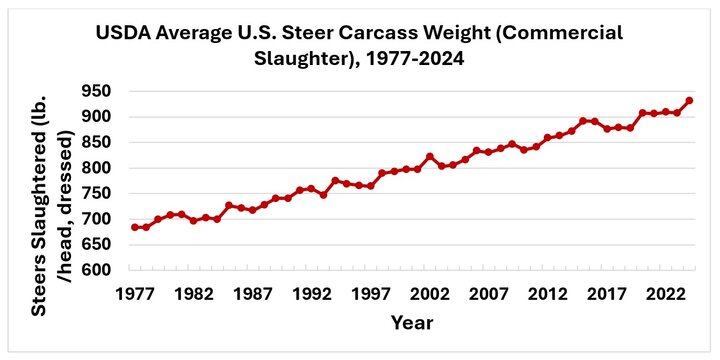
This trend has been driven largely by increased days on feed but is supported by greater genetic potential for growth. Expectedly, hot carcass weights have continuously risen by roughly four pounds per year (approximately seven pounds of live weight annually) (Figure 2).
In many production systems, daughters of bulls purchased to transmit growth and carcass traits are retained as replacements (Figure 3). When matings are designed primarily to maximize feeder calf or feedlot performance, the resulting replacement females may inadvertently reduce efficiency and profitability at the cow–calf level.

Assessing Bulls Within the Management Scheme
For beef operations that market calves at weaning, bull selection typically emphasizes growth traits such as weaning weight (WW) and yearling weight (YW), with consideration given to milk production in daughters. To illustrate how these traits interact with herd objectives, consider the following bulls, commercial cowherd (Table 1), and resulting progeny (Table 2):
Table 1. Example bulls' and cowherd's weaning weights, yearling weights, maternal milk, and maternal weights.
| Animal(s) | WW¹ | YW² | MM³ | MW⁴ |
|---|---|---|---|---|
| Bull A | 70 | 130 | 33 | 107 |
| Bull B | 35 | 62 | 21 | 41 |
| Cowherd | 50 | 80 | 25 | 55 |
¹Weaning weight
²Yearling weight
³Maternal milk
⁴Mature weight
Table 2. Planned mating EPDs are calculated as the average of sire and dam EPDs:
| Animal(s) | WW | YW | MM | MW |
|---|---|---|---|---|
| Progeny A | 60 | 105 | 29 | 81 |
| Progeny B | 42.5 | 71 | 23 | 48 |
Based strictly on EPDs, progeny from Bull A are clearly superior for growth, milk, and mature weight. For an operation that sells all calves as feeders and/or yearlings, Bull A would likely be the preferred option. However, this decision becomes less straightforward when replacement females are retained.
Impacts of Mature Weight and Milking Potential on Feed Costs
Profitability can be expressed as:
Revenue – Expenses = Profit (or Loss)
When replacement females are retained, genetics influence not only revenue through calf performance but also expenses, particularly feed costs. Bull A is expected to sire daughters that are both larger at maturity and higher milking. Both traits increase nutrient requirements, primarily by increasing dry matter intake.
In general, larger cows consume more feed than smaller cows. While outliers exist, management decisions are typically based on averages, and average cow weight still stands as an effective tool for intake estimation. Average cow body weight can be estimated effectively using past cull cow scale tickets; accuracy improves with multiple years of records.
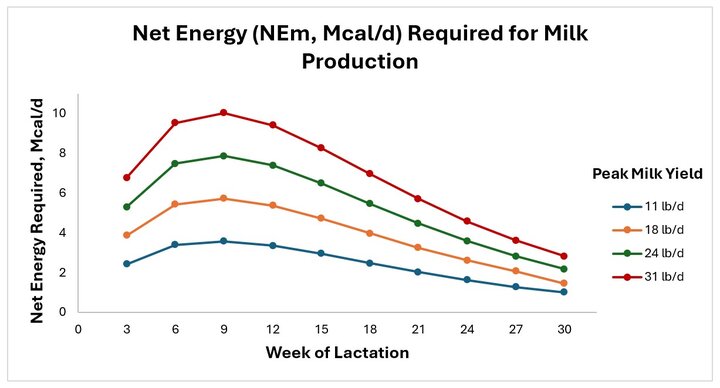
Milk production is also energetically costly (Figure 4). Higher-milking cows require more energy not only during lactation but throughout the production cycle, as milk potential is positively associated with overall maintenance energy requirements. Thus, increased milk and increased mature size exert additive pressure on feed demand. Both maintenance and lactation are at higher priority for nutrient partitioning than rebreeding.
Genetic potential for milk or growth will only be expressed when overall management can support the increase in higher nutrient demands. Without supplementation, in more limited environments, expected gains in calf weaning weight may be reduced, as environmental constraints limit nutrient intake and restrict milk production despite increased grazing pressure.
Whether these added costs are justified depends on whether additional calf revenue offsets higher feed expenses. A 2019 meta-analysis by Lalman et al. reported that each additional pound of cow mature weight resulted in only 0.06 lb of additional calf weaning weight. Accordingly, a 1,400-lb cow would be expected to wean approximately six pounds more calf weight than a 1,300-lb cow. At a favorable calf price of $4.50/lb, this equates to $27 of additional revenue.
Using National Academies of Sciences, Engineering, and Medicine (NASEM) equations, maintaining 100 lb of additional mature cow weight requires roughly 600 lb of high-quality grass hay or equivalent grazed forage annually. At $90/ton forage (excluding waste and feeding costs), this places the breakeven forage cost near the value of the added calf weight. In Nebraska—where grazed forage is among the most expensive in the nation—600 lb of forage (approximately 0.75 animal unit months) would cost an estimated $32–$47 based on regional lease rates reported in UNL’s Annual Land Value Report. This exceeds the value of the additional calf weight, even before accounting for increased intake associated with greater milk production.
Conclusion
Even amid strong calf markets, increased feed costs associated with larger, higher-milking cows often outweigh the marginal gains in calf value. While the short-term benefits of bull selection are readily apparent when feeders are sold, the long-term consequences of retaining replacement females may not be fully realized until those females reach mature size—often five years after birth.
Therefore, when replacement retention is a key component of the production system, selecting bulls with moderate mature weight and milk EPDs may better support long-term cow–calf efficiency and profitability, by reducing unnecessary feed costs and maintaining the level of performance the operation’s resources can realistically support.