Key Points for Producers
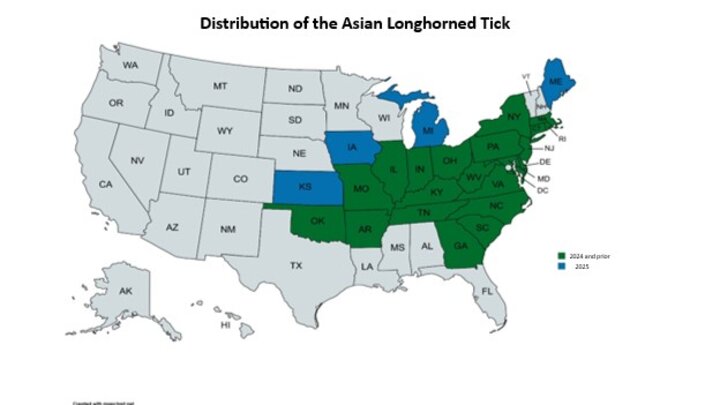
- The Asian Longhorned Tick has not yet been confirmed in Nebraska, but it has been detected in nearby states including Kansas and Iowa.
- This tick can reproduce without mating, allowing populations to increase rapidly once introduced.
- Asian Longhorned Tick can transmit Theileria orientalis Ikeda, a parasite that causes theileriosis in cattle.
- Routine inspection of cattle during handling is one of the most effective ways to detect ticks early.
- Integrated management, including insecticides, pasture management, and careful inspection of new cattle, can help reduce risk.
Why the Asian Longhorned Tick Is a Concern
An invasive tick capable of reproducing rapidly and transmitting disease to cattle has been detected in states neighboring Nebraska, making awareness and early detection increasingly important for livestock producers.
Although the Asian Longhorned Tick (ALHT) has not yet been confirmed in Nebraska, its detection in nearby states such as Kansas and Iowa (Figure 1) suggests that producers in the region should remain alert. Early detection is important because this tick has the potential to establish quickly once it is introduced into favorable environments. Producers should be particularly watchful when cattle are grazing in areas with tall grass, brush, wooded edges, or moist, low-lying habitats where ticks tend to survive and reproduce more easily.
One reason the Asian Longhorned Tick is a concern is its ability to transmit pathogens that affect livestock. Of particular importance is Theileria orientalis Ikeda, a protozoan parasite that infects cattle and causes a disease known as theileriosis. Infected cattle may experience anemia, weakness, reduced appetite, and abortions in severe cases. Heavy tick infestations alone can also cause problems by removing large amounts of blood, which may lead to stress, weakness, and in extreme cases death.
Rapid Reproduction and Population Growth
A unique biological characteristic of the Asian Longhorned Tick is its ability to reproduce without mating. In the United States, populations appear to reproduce primarily through parthenogenesis, meaning females can produce offspring without males. As a result, all offspring are female and capable of reproducing themselves. This allows tick populations to increase rapidly.
A single female can lay between 900 and 3,000 eggs before dying. Under favorable environmental conditions, development from egg to adult can occur in roughly three months, allowing populations to build quickly during the grazing season.
Detecting Ticks on Cattle
Routine inspection of cattle is one of the most effective ways to detect potential tick problems early. Producers should examine animals whenever they are handled for routine management activities such as vaccination, pregnancy checking, branding, or sorting. Special attention should be given to areas where ticks commonly attach, including around the eyes, ears, neck, brisket, tail head, udder, and along the inside of the legs. Because Asian Longhorned Ticks are very small, often the size of a sesame seed, —they can easily be overlooked during quick visual checks.
If producers suspect the presence of unusual ticks or heavy infestations, they should collect several specimens and place them in a small container with alcohol for preservation. These samples can then be submitted to a veterinarian or local Extension office for proper identification. Early reporting helps animal health officials monitor the potential spread of invasive ticks and provide guidance on appropriate management practices.
Management and Prevention Strategies
Management of Asian Longhorned Tick currently relies on integrated approaches that combine insecticide treatments with habitat management. Research indicates that ALHT is highly susceptible to synthetic pyrethroid insecticides. Whole-animal sprays, pour-on products, and oilers or backrubbers can provide effective control when used properly. Producers should always follow pesticide label instructions to ensure safe and effective application.
Pasture management practices can also help reduce tick exposure. Maintaining shorter grass along wooded edges, limiting cattle access to heavily wooded areas, and rotating pastures may help disrupt the tick life cycle and reduce the number of ticks animal’s encounter. Monitoring cattle regularly and responding quickly when ticks are found are important steps in protecting herd health.
Another important consideration is the introduction of new cattle into a herd. Producers purchasing cattle from other regions should determine whether the animals originated from areas where the Asian Longhorned Tick has been reported. Newly purchased animals should be isolated, when possible, checked for Theileria, carefully inspected for ticks, and treated with an approved tick control product before being turned out with the resident herd. Theileria can also be transmitted by sharing vaccinating needles. Employ good Beef Quality Assurance (BQA) practices.
What Nebraska Producers Should Do Now
Producers should monitor cattle for signs that could indicate heavy tick infestations or possible infection with Theileria orientalis. Symptoms may include reduced feed intake, lethargy, fever, breathing difficulty, or abortions in later stages of disease. If cattle become infected, they typically remain carriers for life, and there is currently no direct treatment for theileriosis.
Staying aware of this emerging pest and incorporating routine tick monitoring into herd management programs will help Nebraska producers detect infestations early and respond quickly if the Asian Longhorned Tick eventually appears in the state.